
A time-of-use plan can save money without reducing your total electricity use. It can also raise the bill if too much of that use falls inside expensive hours. The decision depends on how many kWh you use during each price window, rather than how many hours the cheap window lasts.
Our worked example finds a break-even peak-use share of 24.4% after accounting for different monthly fixed charges. That is not a national benchmark or an actual utility offer. Every price and household consumption figure below is hypothetical, chosen to make the comparison reproducible. Start with this method, then replace the inputs with your own tariff and interval data.
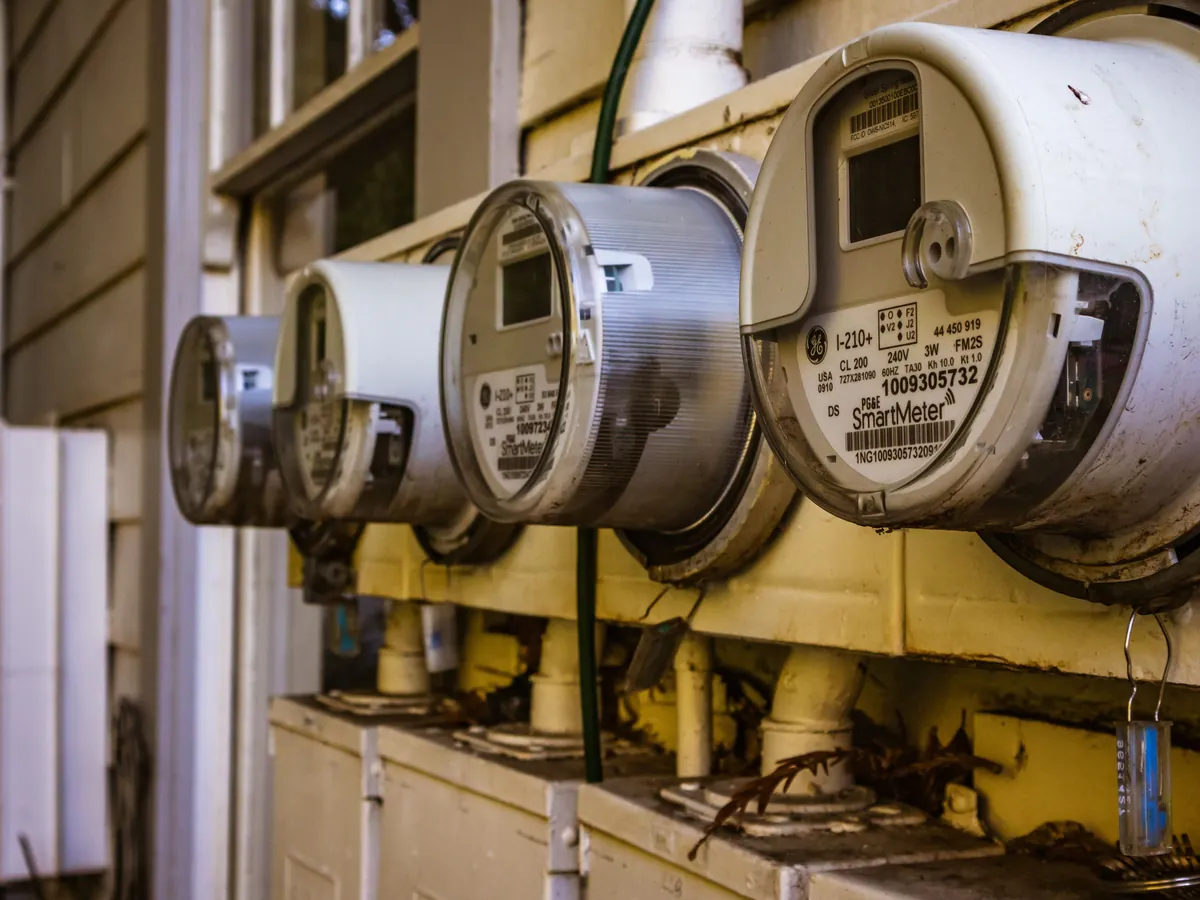
Read the schedule before the price
Time-of-use pricing assigns different energy prices to defined periods. The Department of Energy’s rate guide distinguishes energy charges, demand charges and fixed charges. Moving consumption can affect those components differently; a lower energy charge does not necessarily remove a fixed monthly fee.
Check weekdays, weekends, holidays and summer versus winter schedules. As a real example of schedule differences, PG&E’s residential plan page lists E-TOU-C peak hours as 4–9 p.m. every day, while E-TOU-D uses 5–8 p.m. on weekdays, with weekends and most holidays off-peak. Those schedules are not our example’s prices and do not apply to other utilities.
A five-hour peak window is not automatically five twenty-fourths of your consumption. A household that cooks, heats water, charges a car and runs air conditioning after work may concentrate substantial use in that short period.
Build one comparable month
Assume a household buys 900 kWh per month. Its current flat-rate plan charges $0.25/kWh plus $15 a month. The alternative has two periods: $0.45/kWh peak, $0.20/kWh off-peak, and a $5 monthly fixed charge. We exclude taxes, credits, tiers and demand charges from this deliberately simple exercise.
The current bill is 900 × $0.25 + $15 = $240. To price the alternative, split the same 900 kWh between its two periods. Do not compare one plan before fixed charges with the other after them.
If 30% of consumption falls at peak times, peak use is 270 kWh and off-peak use is 630 kWh. The bill becomes 270 × $0.45 + 630 × $0.20 + $5 = $252.50. The time-of-use plan costs $12.50 more that month, even though most electricity is bought at the cheaper rate.
Find the peak share that breaks even
Let p be the fraction of monthly kWh consumed during the peak window. The alternative bill is:
900 × [p × $0.45 + (1 − p) × $0.20] + $5 = $185 + $225p.
Set that equal to the flat-rate bill of $240. Then $225p = $55, so p = 0.2444, or 24.4%. Below that share, the alternative is cheaper in this example. Above it, the flat-rate plan is cheaper. At the threshold, about 220 kWh is consumed at peak times and 680 kWh off-peak.
If both plans had the same fixed charge, the threshold would instead be 20%. The alternative’s $10 lower monthly fee creates a little extra headroom. This is why the advertised energy rate alone cannot settle the comparison.
The general two-period formula is:
Break-even peak share = [flat energy rate + (flat fixed charge − TOU fixed charge) ÷ monthly kWh − off-peak rate] ÷ (peak rate − off-peak rate).
Use dollars per kWh consistently. If the result is below zero, even the all-off-peak case is more expensive under these simplified inputs. A threshold above 100% means even the all-peak case is cheaper. If peak and off-peak prices are equal, there is no meaningful peak-share threshold; compare the two bills directly.
What moving 100 kWh actually saves
Suppose the household can move 100 kWh from peak to off-peak while keeping total use at 900 kWh. Savings are 100 × ($0.45 − $0.20) = $25 on the time-of-use plan.
The alternative bill falls from $252.50 to $227.50, now $12.50 below the flat plan. That is $150 over twelve identical months. Real seasonal use and prices will differ, so do not multiply one favorable winter month into a guaranteed annual saving.
For scale, an assumed 25-kWh charging session moved four times creates the example’s 100-kWh shift. That is arithmetic, not a claim that every EV session uses 25 kWh. Our home EV charging guide explains why charging losses and driving needs belong in the estimate.
A dryer or dishwasher may offer a useful scheduling window, but first estimate its actual kWh. A delay button does not establish a $25 saving on its own. Follow the appliance’s operating instructions and choose times when it can be used appropriately in your household.
Separate bill savings from energy savings
Load shifting changes when electricity is purchased. Efficiency changes how much is purchased. They can work together, but do not count the same improvement twice.
If shifting a heating schedule adds recovery consumption, compare the complete day’s kWh at their applicable prices. If a battery charges from the grid, include charging losses, purchase cost and cycling assumptions. Avoided peak purchases are not pure profit. Solar export credits also require separate treatment; see our solar quote audit.
Heat pumps add a control complication. Aggressive temperature recovery can call for resistance backup, so a plan that looks attractive from rate windows alone may behave differently after a deep setback. Our heat-pump thermostat guide covers that operating-cost comparison.
Use a year of interval data
Ask your utility for consumption by half-hour, hour or its available interval. Map each interval to the proposed tariff, including seasonal changes and holidays. Sum the resulting bills over the same year under both plans.
Then rerun a realistic schedule change rather than assuming everything can move. Cooking, medical equipment, comfort needs and work patterns can constrain flexibility. Keep those constraints in the base case; treat a more ambitious schedule as a separate scenario.
If a plan has tiers, demand charges, minimum bills, special EV windows or credit restrictions, the two-period formula is incomplete. Use the utility’s comparison service or a tariff model that includes those features. A small modeled saving is less convincing when the billing rules or usage pattern remain uncertain.
Before changing plans
Save the tariff’s effective date, applicable fees, eligibility and switching rules. Confirm whether an offer expires or requires another service. A lower off-peak price is useful only if the overall plan fits the electricity you actually buy.
You can reduce demand separately with the steps in our electric bill guide. Use the bill estimator for a simple consumption budget, but do not use its single average rate to claim a detailed time-of-use comparison.
FAQ
Is a time-of-use plan always better for an EV owner?
No. Charging may be flexible, but the plan can also reprice the rest of the home’s consumption. Compare the whole account, including daytime and evening use, rather than the car alone.
Does a smart meter guarantee a cheaper plan?
No. It can support interval billing and help reveal consumption patterns. Prices and eligibility come from the tariff, and your bill depends on how your use aligns with it.
Where did the example’s rates come from?
They were chosen for this original comparison and are not a quoted offer. DOE supports the distinction between bill components; PG&E illustrates differing schedules. Sources checked October 22, 2026.