
A 100-watt heated throw costs about $2.20 a month to run for four hours a day at the EIA’s July 2026 US average electricity rate. A 1,500-watt space heater costs about $32.96 for the same hours if its element stays on continuously. These are calculated running costs, not measured household savings. A throw warms the person using it; a space heater supplies heat to the room. Whether one replaces the other is the question that determines the saving.
We checked a current Sunbeam heated throw specification, which lists 100 watts, on October 10, 2026. The heater wattages below are comparison inputs. Read your own product label, since settings and thermostat cycling change consumption.
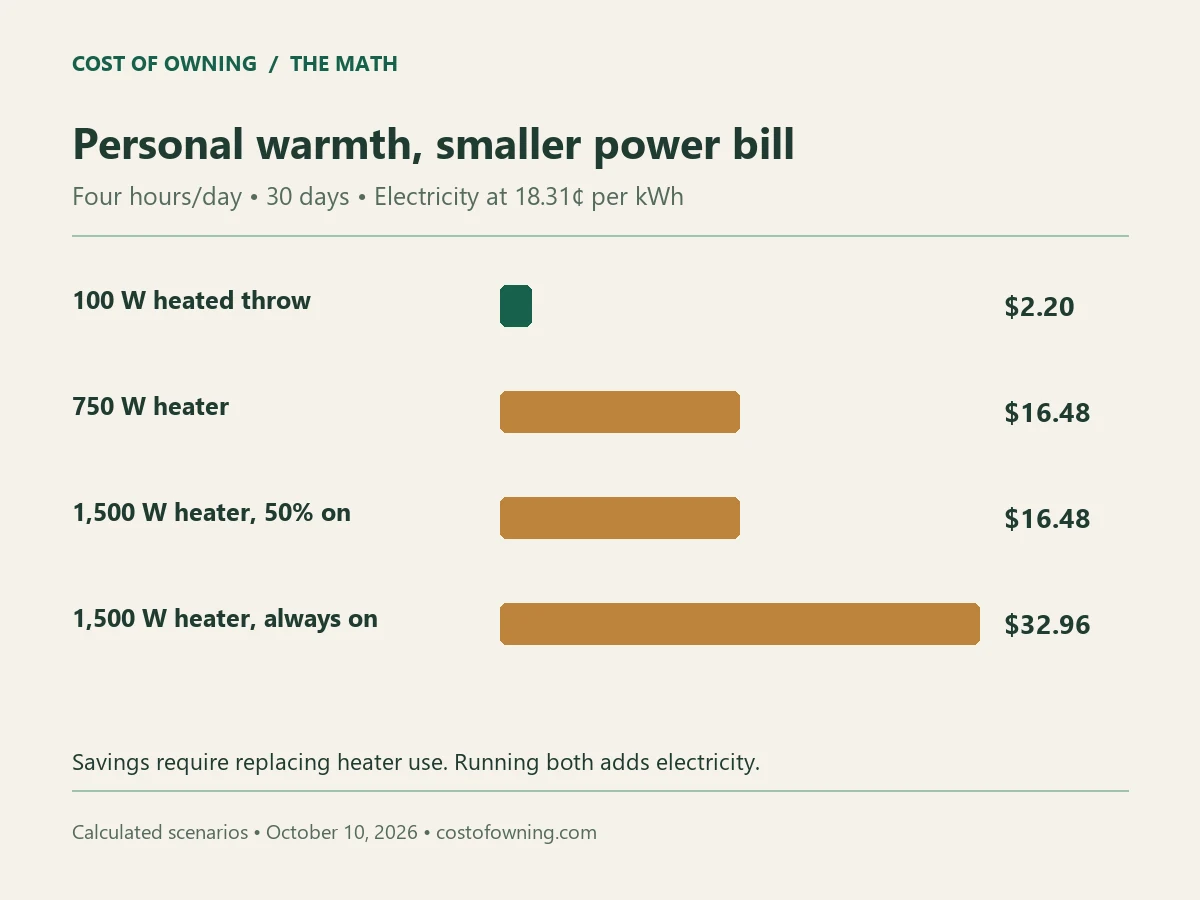
The Monthly Electricity Math
The formula is watts ÷ 1,000 × hours per day × days × price per kWh. At the EIA’s July 2026 US residential average, price is $0.1831 per kWh. We use 30 days to make the monthly examples comparable.
| Rated power, continuously on | Four hours daily | Eight hours daily |
|---|---|---|
| 60 W, illustrative smaller load | $1.32/month | $2.64/month |
| 100 W throw example | $2.20/month | $4.39/month |
| 200 W, illustrative larger load | $4.39/month | $8.79/month |
| 750 W heater input | $16.48/month | $32.96/month |
| 1,500 W heater input | $32.96/month | $65.92/month |
The eight-hour column is a cost comparison, not advice to operate either product while sleeping. Use the manufacturer’s instructions for the approved setting, duration and supervision. A lower setting may cycle the heating element rather than draw the rated power continuously.
For the 100 W throw at four hours, electricity is 0.1 × 4 × 30 = 12 kWh. For the heater, it is 1.5 × 4 × 30 = 180 kWh. That difference of 168 kWh is worth $30.76 at our rate, provided the throw lets you stop running the heater for all four hours.
Thermostat Cycling Narrows the Gap
A 1,500 W label describes power while the element is on. If a thermostat leaves it on only half the time, four clock-hours represent two equivalent full-power hours.
| Four-hour daily session | Assumed monthly kWh | Calculated cost |
|---|---|---|
| 100 W throw, on throughout | 12 | $2.20 |
| 1,500 W heater, 25% element-on time | 45 | $8.24 |
| 1,500 W heater, 50% element-on time | 90 | $16.48 |
| 1,500 W heater, 100% element-on time | 180 | $32.96 |
These duty cycles are assumptions, not measurements of any heater. With 50% cycling, replacing the heater session saves $14.28 a month, rather than $30.76. If both devices run, the throw adds consumption; it does not save the heater’s electricity.
Our space heater calculator includes hours, rate and element-on percentage. Use the custom-wattage setting for your throw. Our space heater running cost guide covers different heater settings in more detail.
Your Electricity Rate Matters
Hold use at four hours daily and continuous rated power. The throw uses 12 kWh a month and the heater 180 kWh. Substitute your actual variable electricity price, including applicable per-kWh delivery charges. An existing fixed monthly charge usually remains even if you reduce consumption.
| Assumed rate | 100 W throw | 1,500 W heater | Difference |
|---|---|---|---|
| $0.12/kWh | $1.44 | $21.60 | $20.16 |
| $0.1831/kWh | $2.20 | $32.96 | $30.76 |
| $0.30/kWh | $3.60 | $54.00 | $50.40 |
| $0.45/kWh | $5.40 | $81.00 | $75.60 |
On a time-of-use tariff, price the evening session at the evening rate. An annual state average can obscure the expensive hours. Our electric bill estimator helps connect the kWh difference to the rest of your bill.
Can the Purchase Pay for Itself?
We could verify the throw’s wattage but are not quoting a checked retail price. Assume you spend $50 on a suitable throw and already own the heater. If it replaces four hours daily of full-power 1,500 W heating, the $30.76 monthly saving covers that purchase in about 1.6 months of actual use.
If the heater previously cycled at 50%, the $14.28 monthly saving gives about 3.5 months of use. If you use it only one month each winter, the calendar payback is correspondingly longer. Do not spread a seasonal saving across twelve months unless the device is actually used year-round.
This calculation excludes repairs and replacement. It also assumes the new throw fully replaces the heater during that session. If you use it while leaving the heater unchanged, there is no energy payback from displacement.
Personal Warmth and Room Temperature
A throw can be a useful option when one person is sitting at a desk or on a sofa and the room is already adequately heated. It cannot protect pipes, warm an entire household or replace the minimum indoor temperature your circumstances require.
Turning down central heat may create additional savings, but this article does not assign a percentage to that change. Savings depend on the building, weather, heating equipment, thermostat setting and rooms involved. Our winter heating cost guide puts whole-home fuel spending in context.
Compare actual consumption before and after if you want a household saving figure. Keep occupied hours and weather in mind: a warmer week can make a new device look more effective than it is. The wattage comparison remains useful even when your whole-home bill varies for other reasons.
Use the Product Safely
Check instructions and recall notices for the exact model before use. Inspect the cord and controller, and stop using damaged equipment. Do not assume that a heated throw is approved for use under other bedding or during sleep.
For space heaters, the CPSC’s winter guidance says to plug directly into a wall outlet rather than an extension cord or power strip. It also advises separation from combustible materials and turning heaters off when unattended or sleeping. Cost savings are useful only within the safe operating instructions.
FAQ
How much does a 100 W electric throw cost to run?
At four hours daily for 30 days and 18.31 cents per kWh, about $2.20. The calculation assumes continuous rated draw; a cycling controller may use less.
Is a heated blanket cheaper than a space heater?
At our 100 W versus 1,500 W comparison inputs, yes for electricity. The products do different jobs, so household savings require the throw to replace some heater use.
How much can I save over a winter?
Replacing four hours daily of continuous 1,500 W heating with 100 W for three 30-day months saves about $92.28 at our rate. With 50% heater cycling, the corresponding saving is about $42.85.
Does a lower heater setting change cost?
Yes. A lower wattage or less element-on time reduces kWh. Compare actual settings and hours instead of assuming every heater always draws its maximum rated power.