
A 2,200-watt inverter generator costs $1,199, a 7,500-watt dual-fuel machine $1,149 to $1,300, and a 12,000-watt class unit $2,299 and up. Over ten years of typical use, our calculation puts total ownership at about $1,900 to $2,400 for the small unit and $3,250 to $6,100 for the 7,500-watt class. The sticker price is only the first line. Fuel, maintenance and a legal connection to the house decide the rest.
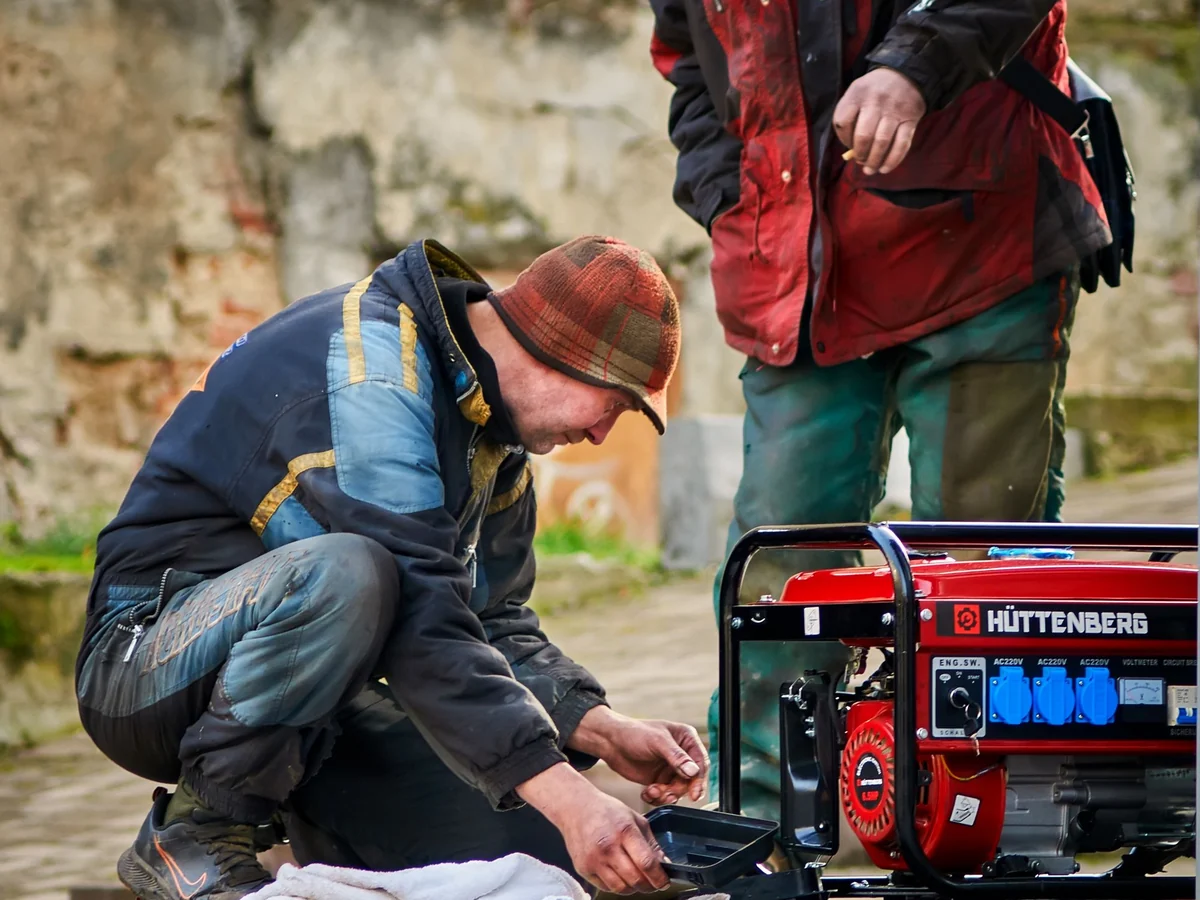
What Each Size Class Costs to Buy
Generators are priced in steps, not as a single national average. Three current examples, checked October 19, 2026:
| Class | Example | Price | Fuel burn | Run time |
|---|---|---|---|---|
| 2,000 W inverter | Honda EU2200i | $1,199 MSRP | 0.30 gph at 1,800 W | 3.2 h on 0.95 gal |
| 7,500 W dual fuel | Champion 201281 | $1,149 to $1,300 | 0.77 gph at 50% | 10 h on 7.7 gal |
| 12,000 W+ | Westinghouse iGen12000TFc | $2,299 | 0.72 gph at 50% | 11 h on 7.9 gal |
The same Honda burns 0.117 gallons an hour and runs 8.1 hours at a quarter load. Westinghouse’s WGen7500DF lists 6.6 gallons over 11 hours at 25% load, 0.60 gph, which is not the same test as Champion’s 50% rating. Read the load before comparing run times.
Fuel Is the Real Meter
The EIA’s October 12, 2026 survey, checked October 19, 2026, puts regular gasoline at $4.331 a gallon nationally, $3.851 on the Gulf Coast and $5.639 on the West Coast. Multiply burn rate by price (our calculation): the small inverter costs $1.30 an hour at rated load and $0.51 at quarter load, the 7,500-watt class $3.33 an hour at 50%, the 12,000-watt inverter $3.12, and a conventional 12,000-watt unit at 0.95 gph $4.11.
| 24-hour outage at 50% load | Fuel per hour | Fuel per day |
|---|---|---|
| 2,200 W inverter (rated load) | $1.30 | $31 |
| 7,500 W dual fuel | $3.33 | $80 |
| 12,000 W inverter | $3.12 | $75 |
| 12,000 W conventional | $4.11 | $99 |
On the West Coast the 7,500-watt machine runs $4.34 an hour and $104 for that same day. Propane changes the shape. The EIA lists residential propane at $2.64 a gallon on October 12, 2026, checked October 19, 2026, and a 20-pound tank holds about 4.7 gallons. Champion rates its 7,500-watt unit at 5.5 hours on that tank at 50% load, so fuel works out to $2.25 an hour and about $54 for 24 hours (our calculation). Propane is cheaper per hour, but it derates the machine to 6,750 running watts and needs a refill every 5.5 hours.
Ten Years, With One Bad Outage Year
The profile: 40 hours of use a year plus a single 150-hour outage year. That is how the totals line up.
| Ten-year line | 2,200 W inverter | 7,500 W dual fuel | 12,000 W inverter |
|---|---|---|---|
| Purchase | $1,199 | $1,149 | $2,299 |
| Fuel, 40 h a year | $204 | $1,333 | $1,250 |
| Extra fuel, one 150-hour outage | $77 | $500 | $468 |
| Maintenance, oil and plugs | $250 | $600 | $750 |
| Connection: cords or interlock installed | $75 | $600 | $600 |
| Repair reserve | $200 | $300 | $400 |
| Total, ten years | about $2,000 | about $4,500 | about $5,800 |
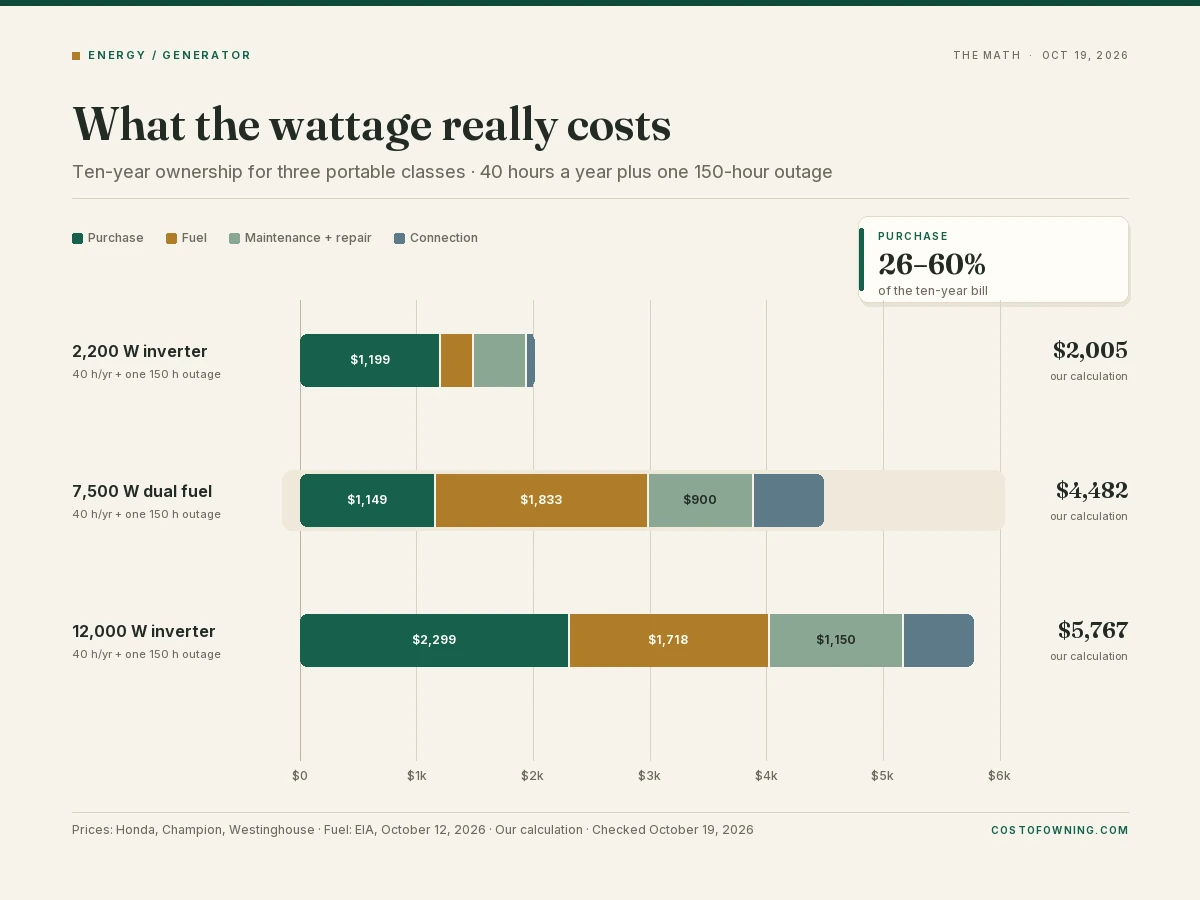
Fuel for the 2,200-watt inverter assumes quarter load; the 7,500-watt and 12,000-watt rows assume 50% load.
Fuel prices and outage length swing those totals by 30% or more. At Gulf Coast prices with light use the 7,500-watt machine lands near $3,250; with West Coast prices and two long outages it passes $6,100. The small inverter stays near $1,900 to $2,400 because it never carries a house.
Inverter or Conventional, and What Size
Running watts are what a device uses continuously. Starting watts are the surge a motor draws for a second or two, often two to three times running watts. The Champion 201281 carries 7,500 running and 9,375 starting watts on gasoline, and 6,750 running with 8,400 starting watts on propane. Add the nameplate running watts you plan to use, add the largest motor’s starting watts, then compare that sum with the generator’s starting rating, not its running rating.
The connection comes before the watts. HomeGuide’s 2026 pricing puts a manual transfer switch at $200 to $800 for the part and $400 to $1,300 installed, an interlock kit at $50 to $150 for parts and $400 to $850 installed, plus a $50 to $350 permit. A 10-circuit kit such as Reliance’s 310CRK lists around $475 at Home Depot, all checked October 19, 2026. A 30-amp switch matches a 7,500-watt machine and 50 amps matches 12,000 watts, so the switch, inlet and breaker have to match the generator.
Never connect a generator to house wiring with a double-male cord. Backfeeding energizes lines that utility crews believe are dead, and it is illegal in many places. Inverters are quieter and produce cleaner power for electronics but cost more per watt; conventional units are cheaper and louder, with most 7,500-watt open-frame models rated about 74 dBA at 23 feet. Hire a licensed electrician for the interlock or transfer switch.
Safety, Storage and Maintenance
CPSC’s January 2026 guidance is blunt: run a generator outdoors only, at least 20 feet from the home, with exhaust pointed away, and never inside a home, garage, basement or shed. The agency links roughly 750 carbon monoxide deaths to generators between 2012 and 2022 and warns against refueling a running unit. Working CO alarms on every level and outside sleeping areas are the cheapest line in this budget.
Cords and fuel carry their own rules. Match a 20-amp outlet to a 12-gauge cord, keep runs short and skip daisy chains. OSHA caps flammable liquid storage outside an approved cabinet at 25 gallons, so a 5-gallon can plus a spare is plenty; rotate gasoline with stabilizer and store propane upright outdoors, never in a hot vehicle.
Maintenance is where a neglected machine becomes a repair bill. Champion’s guidance calls for the first oil change after 5 hours, then intervals near 100 hours. Walmart lists 10W-30 oil at $4.62 a quart and STA-BIL at $13.58 for 32 ounces, checked October 19, 2026. Budget $25 to $75 a year and the ten-year table holds.
Power Station or Standby Instead?
Our portable power station worksheet compares stored energy, output limits and the loads a battery would need to support. Compare those requirements with a generator’s running and starting ratings before comparing purchase and fuel costs.
For heat during an outage, a 1,500-watt space heater eats most of a 2,200-watt inverter’s capacity and much of a 7,500-watt machine’s spare headroom once a fridge and furnace blower are running. Our space-heater worksheet explains watts and powered-on hours, but its utility-rate examples do not price generator fuel.
FAQ
Is a bigger generator always better?
No. Fuel burn tracks the load, and a 12,000-watt machine can burn 0.72 to 0.95 gallons an hour even when it is coasting. Buy for the starting watts you actually need.
How much does a generator cost per hour to run?
Our calculation, at $4.331 gasoline: $0.51 an hour for a 2,200-watt inverter at quarter load, $1.30 at rated load, $3.33 for a 7,500-watt unit at 50% and $3.12 to $4.11 for 12,000-watt units.
Do I need a transfer switch?
If the generator feeds household wiring, yes. A manual switch, interlock kit or automatic switch installed by a licensed electrician prevents backfeeding. Appliances run from cords do not need one.
Does propane cost less than gasoline?
Per hour, usually. At $2.64 a gallon the 7,500-watt example runs about $2.25 an hour on propane against $3.33 on gasoline. The trade-offs are reduced output, 6,750 running watts, and a 20-pound tank that lasts 5.5 hours at half load.