
The electricity to recharge a small portable power station is cheap. The battery is the expensive part. Replenishing 1 kWh of stored energy costs about 20 cents at the EIA’s July 2026 US residential average, if we assume 90% charging efficiency. But a 1 kWh battery also runs out quickly under a heavy load: our 85%-usable-energy scenario gives 8.5 hours at 100 watts and only 34 minutes at 1,500 watts.
October’s backup-power promotions make this a useful comparison before winter. Ignore the size of an advertised discount until you know what the machine can keep running. We read the current manufacturer specifications for two roughly 1 kWh models on October 10, 2026. Their pages did not expose a reliable standalone US checkout price, so the purchase budgets below are explicitly hypothetical. We did not test either unit.

Capacity and Output Are Different
Capacity in watt-hours, or Wh, describes how much energy the battery stores. Output in watts, or W, describes how much power it can deliver at once. A high output rating does not mean a large store of energy.
| Manufacturer specification | EcoFlow DELTA 3 Plus | Jackery Explorer 1000 v2 |
|---|---|---|
| Battery capacity | 1,024 Wh | 1,070 Wh |
| Rated AC output | 1,800 W total | 1,500 W total |
| Advertised surge output | 3,600 W | 3,000 W |
Sources: EcoFlow US product specifications and Jackery US product specifications, checked October 10. These are manufacturer ratings. Confirm that your appliance’s running and startup requirements fit the exact model; a surge rating alone does not guarantee compatibility.
A battery with 1,000 Wh and a 1,500 W outlet can theoretically power a 1,500 W load for two-thirds of an hour before losses. It cannot power that load all night just because the outlet supports it.
What a 1 kWh Battery Can Run
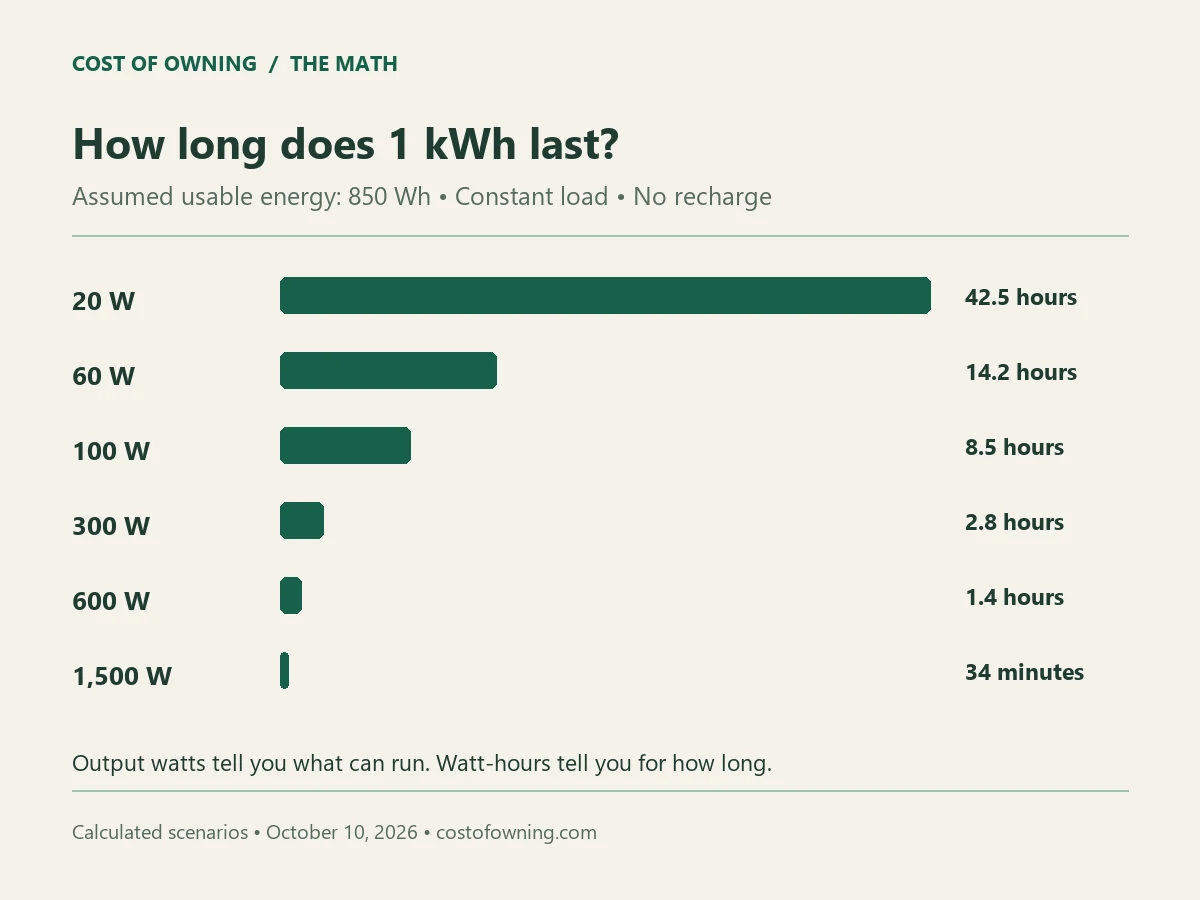
For planning, we assume 85% of nominal capacity reaches the AC load. This allowance combines conversion loss and reserve in one simplified input. It is not a measured efficiency figure for the products above. Runtime is usable Wh divided by average W.
| Illustrative constant load | Runtime from assumed 850 Wh |
|---|---|
| 20 W | 42.5 hours |
| 60 W | 14.2 hours |
| 100 W | 8.5 hours |
| 300 W | 2.8 hours |
| 600 W | 1.4 hours |
| 1,500 W | 0.57 hours, about 34 minutes |
The numbers are loads, not claims about typical devices. Measure your router, laptop or refrigerator rather than assigning it a wattage from this table. A refrigerator cycles, so its average over hours differs from its compressor’s running watts. It can also demand a higher startup load. Our appliance electricity worksheet explains the difference between annual label energy, measured kWh and instantaneous watts.
For a variable load, use a measured daily kWh figure where possible. A device consuming an assumed 1.2 kWh per day averages 50 W. Our 850 Wh battery scenario covers about 17 hours of that average energy demand, subject to the device starting successfully and the station’s own idle draw.
Recharge Cost
The historical July 2026 US residential observation is 18.31 cents per kWh, preserved in Table_5_06_A.xlsx from EIA’s September 2026 archive. It is not the latest release or a current utility tariff. To put 1 kWh back into a battery at our assumed 90% charging efficiency, buy 1 ÷ 0.90 = 1.111 kWh from the wall. Repriced at that benchmark, it costs $0.2034, rounded to 20 cents.
EIA’s revenue-per-kWh average includes fixed charges spread across usage. These are illustrative energy-cost scenarios, not exact additional charging costs or avoided bill savings. Use your usage-linked tariff for energy bought or avoided; unchanged service fees remain payable.
Clarification, October 28, 2026: the July observation is a historical benchmark from the September archive, not a claim about the latest release or current household tariff. Runtime and numerical budget scenarios are unchanged.
| Assumed electricity rate | Cost to replenish 1 kWh stored |
|---|---|
| $0.12/kWh | $0.13 |
| $0.1831/kWh | $0.20 |
| $0.30/kWh | $0.33 |
| $0.45/kWh | $0.50 |
This excludes standby consumption between uses. If you keep a station connected for automatic backup, its idle draw and pass-through behavior matter. Include that continuous consumption in the energy budget rather than counting only the energy delivered during an outage.
Three Purchase-Price Scenarios
Because we could verify specifications but not reliable checkout prices, use your actual tax-inclusive quote in place of these assumptions. Hold the battery size at 1 kWh, recharge it fully 50 times a year, and use the rate and charging-efficiency assumptions above.
| Assumed purchase price | Five years of recharge electricity | Five-year subtotal |
|---|---|---|
| $400 | $50.86 | $450.86 |
| $700 | $50.86 | $750.86 |
| $1,000 | $50.86 | $1,050.86 |
We calculated 250 equivalent full recharges × $0.2034. The subtotal excludes solar panels, cables, extra batteries, standby draw, repair, replacement and finance costs. At these use levels, saving $100 on a suitable purchase matters much more than shaving a few cents from a recharge.
Is a Solar Panel Worth Adding?
Do not confuse free sunlight with free equipment. A panel must match the power station’s voltage, connector and input requirements. Its rated watts also are not guaranteed production throughout the day.
For an intentionally simple example, assume a $300 panel-and-cable purchase avoids all 50 yearly grid recharges in the scenario above. Avoided electricity is only $10.17 a year, giving a simple energy-cost payback of about 29.5 years. That is our scenario calculation, not a forecast of panel life or performance.
The stronger reason to buy a compatible panel may be replenishment during a prolonged outage or off-grid use. That is a different benefit from utility-bill savings. If the purchase is for home backup, our portable generator guide covers another equipment and installation scope. Compare which loads each proposal actually supports.
Buy Around the Load List
List the devices that must work, their average energy demand, startup needs and required hours. Keep high-power heating out of a small-battery plan unless you have explicitly sized for it. Our space heater calculator can price the electricity, while the runtime table shows how quickly that demand drains stored energy.
Use the manufacturer’s instructions for charging, placement, temperature and compatible connections. A portable station’s outlets are for supported loads; connecting it to household wiring requires equipment designed for that purpose and professional installation. Price that work separately.
FAQ
How much does it cost to recharge a 1 kWh power station?
About 20 cents at 18.31 cents per kWh if charging efficiency is an assumed 90%. Your rate, the energy replenished and standby consumption change the total.
How long will a 1 kWh power station run a refrigerator?
Use measured average consumption and check startup requirements. At an assumed 50 W average and 850 Wh usable battery energy, the calculation gives 17 hours. That is not a guaranteed refrigerator runtime.
Can a small power station run a space heater overnight?
Not at a continuous 1,500 W in our 1 kWh scenario. With 850 Wh usable energy, runtime is about 34 minutes. The heater may fit the outlet rating while exhausting the battery quickly.
Does a solar panel save enough to pay for itself?
At occasional backup use, avoided grid electricity can be small. Compare panel cost with actual yearly energy harvested, and value outage replenishment separately from bill savings.