
A hot tub is a decade-long purchase sold with a sticker price. A mid-range 350-gallon acrylic spa with about $12,000 in purchase and site costs runs roughly $27,800 over ten years by our calculation, or $232 a month. Electricity alone costs $549 a year in a mild climate and $1,190 in a cold one at the July 2026 national average of 18.31 cents per kWh, before chemicals, filters, and repairs.
The ten-year bill, in three scenarios
Showroom prices cover the shell and the marketing. The table below combines verified 2026 prices with our run-cost model; the repair column is a reserve, not a prediction, assuming normal wear on heaters, pumps, and covers.
| Scenario | Upfront (spa + site) | Electricity, 10 yrs | Chemicals and filters, 10 yrs | Repair reserve, 10 yrs | Ten-year total | Per month |
|---|---|---|---|---|---|---|
| Budget inflatable or plug-in | $750 | $8,240 | $2,500 | $1,250 | $12,740 | $106 |
| Mid-range acrylic (spa about $9,500) | $12,050 | $8,790 | $3,750 | $3,200 | $27,790 | $232 |
| Premium spa, about $18,000 | $23,050 | $10,253 | $5,000 | $4,800 | $43,103 | $359 |
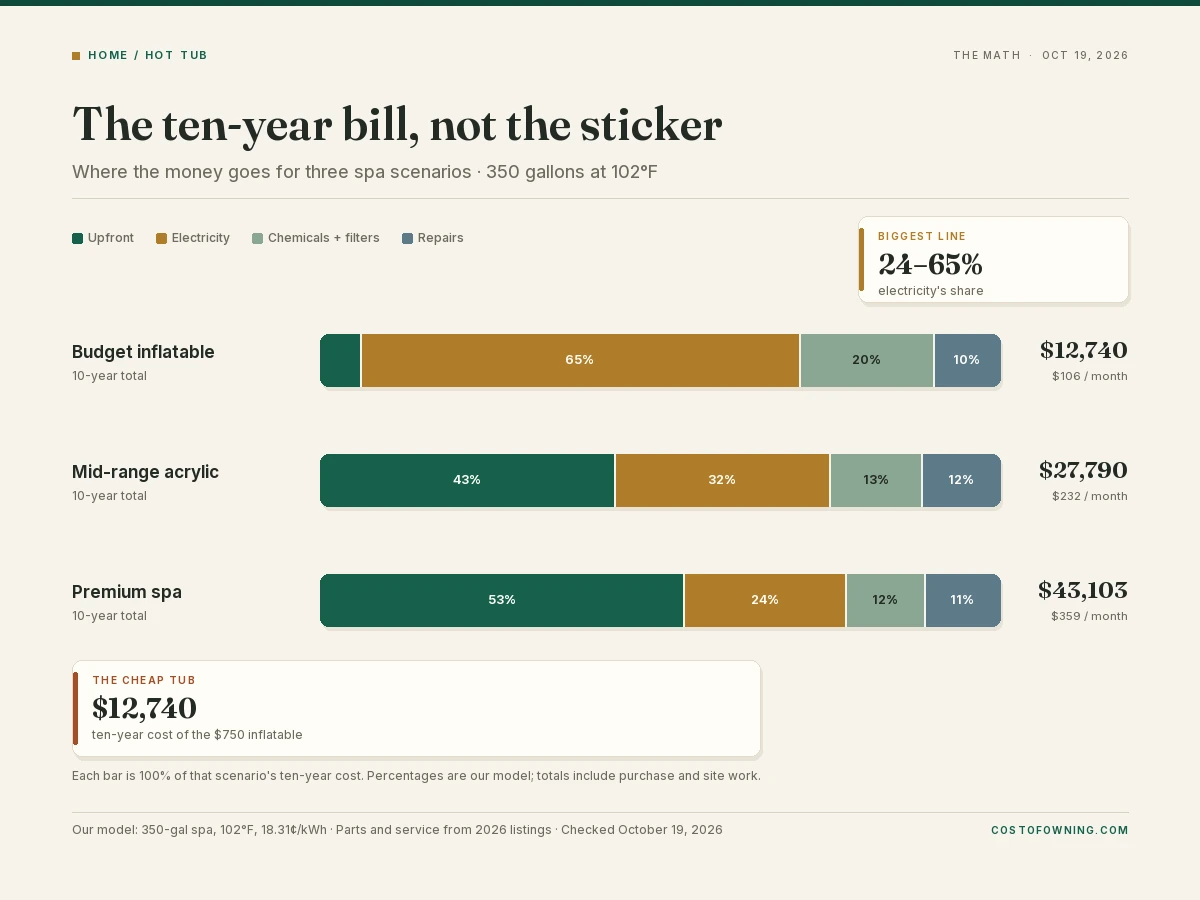
Upfront money is 43% of the mid-range total, electricity is the largest recurring line everywhere, and a cheap tub is not a cheap outcome: an inflatable selling for $525 to $700 (Bestway’s SaluSpa lineup, checked October 19, 2026) still draws an estimated 4,500 kWh a year and lands near $12,700.
Electricity is the biggest recurring line
Our model holds a 350-gallon spa with a 49-square-foot surface at 102°F, using furnace-load arithmetic applied to water. The key assumptions:
- Water volume and surface: 350 gallons under 49 square feet of cover.
- Setpoint: 102°F year-round.
- Cover: about R-14 when new, degrading toward R-8 once waterlogged.
- Shell: about R-12 in a mid-range cabinet, near R-5 in a budget shell.
- Outdoor temperature: 60°F mean in the mild case, 42°F in the cold case.
- Heater efficiency: resistance heat converts nearly all input energy into heat, so lost heat returns as kilowatt-hours, roughly 1-to-1.
Heat loss runs on area times temperature difference divided by R-value. In the mild case the cover passes 49 x 42 ÷ 14, about 147 BTU an hour, or 1.0 kWh a day, and the shell adds roughly 2.2 kWh. Open-cover time, the pumps, and warm-up add about 5.0 kWh, for a total of 8.2 kWh a day, 3,000 kWh a year.
| Daily heat line | Mild climate | Cold climate |
|---|---|---|
| Mean outdoor temperature | 60°F | 42°F |
| Cover in service | R-14 (4-inch) | R-8 (3-inch, worn) |
| Loss through cover and shell | 3.2 kWh | 12.1 kWh |
| Open-cover use, pumps, warm-up | 5.0 kWh | 5.7 kWh |
| Total per day | 8.2 kWh | 17.8 kWh |
| Total per year | 3,000 kWh | 6,500 kWh |
| Cost at 18.31¢/kWh | $549 a year (about $46 a month) | $1,190 a year (about $99 a month) |
Rates matter as much as the model. The EIA’s July 2026 electricity report puts the residential average at 18.31¢ per kWh, with Hawaii at 48.00¢ and North Dakota at 13.41¢ (checked October 19, 2026): the same mild-climate spa costs about $1,440 a year in Hawaii and $402 in North Dakota. Jacuzzi’s connected-spa data shows a median near 6 kWh a day, about 2,190 kWh a year, and $20 to $40 a month in moderate climates (Jacuzzi, checked October 19, 2026), while Hot Spring tests its models in a third-party chamber at 102°F (Hot Spring). A cover that does not seal does not work, so for household fixes see how to lower an electric bill and appliance electricity costs per month.
Water, chemicals, and filters
A 350-gallon spa gets drained and refilled three or four times a year, about 1,400 gallons of water. Sanitizer, testing, and cartridges do the rest.
| Consumable | Low per year | High per year |
|---|---|---|
| Refill water, about 1,400 gallons | $15 | $50 |
| Sanitizer (dichlor or bromine) | $110 | $260 |
| Test strips | $20 | $35 |
| Clarifier and cleaners | $25 | $60 |
| Filter cartridges | $80 | $195 |
| Total | $250 | $600 |
SpaDepot lists dichlor granules at $19.95 for 2 pounds and $43.95 for 5 pounds, with test strips around $9.95 to $10.95 (SpaDepot, checked October 19, 2026). Cartridges are the wild card: inflatable models run under $20 for a two-pack, while acrylic spas often want $60 to $150 a year.
The spa is not the whole installation
Jacuzzi’s installation guide separates the lines buyers forget: delivery $200 to $500 curbside, a crane $800 to $1,500 or more where a yard has no wide gate, a concrete pad $600 to $2,000 or more (prefab spa pads run $200 to $600), a 240-volt circuit $600 to $2,200 or more, and permits $100 to $500 (Jacuzzi, checked October 19, 2026). A replacement cover adds $400 to $800, a lifter $250 to $700, and a mid-size spa lands at $11,500 to $15,500 all-in.
Two lines catch people off guard: the 240-volt circuit needs a licensed electrician, an exterior GFCI breaker, and usually a permit and inspection; and access, because a filled spa weighs several thousand pounds and a crane bill appears when the truck cannot reach the pad. Our scenario table folds all site costs into “upfront.”
What breaks first, and what it costs in 2026
Parts pricing was checked October 19, 2026, and service ranges come from published repair guides:
- Heater: $150 to $700 installed; elements run $25 to $160 and assemblies $120 to $370 before labor (SpaDepot heater lineup, checked October 19, 2026).
- Pump: $300 to $1,000 or more installed; seal leaks are the usual trigger.
- Control board: $300 to $1,000, and moisture kills more boards than use does.
- Cover and lifter: lifters run $65 to $330 as parts, while a fitted cover runs $300 to $800 installed.
- Ozonator or UV cartridge: the first electronic part to fail, often inside five years; many owners simply leave it disconnected.
Labor runs $75 to $200 an hour, with minor visits at $200 to $500 and major repairs at $500 to $1,500 or more (HomeGuide, checked October 19, 2026). Our table reserves $400 a year for the mid-range spa and $600 for the premium one, starting around year three. Two blowups sit outside that reserve on purpose: freeze damage when a filled spa loses power in a hard freeze, and chemistry damage from months of drifting pH.
Safety, permits, and the used-tub trap
A hot tub is a permanent electrical appliance sitting in water. The non-negotiables: a 240-volt circuit on a GFCI breaker, installed and inspected to local code; a permit in most jurisdictions, confirmed with the building department before delivery day; a level, rated foundation, since a filled 350-gallon spa weighs about 4,000 pounds with bathers; and a locking cover, because the water stands at 102°F whether or not anyone is looking. Manufacturers cap setpoints at 104°F for a reason, and children should never have unsupervised access.
A used spa looks like a $500 shortcut and rarely is: a 700- to 900-pound empty shell, no warranty, a tired heater, a waterlogged cover. Budget $1,000 to $2,000 beyond the purchase price to make one runnable, and keep a repair reserve separate from the purchase price.
FAQ
How much does a hot tub add to the electric bill each month? About $46 a month for a 350-gallon acrylic spa in a mild climate and $99 in a cold one at the July 2026 national average of 18.31¢ per kWh. Your state’s rate and cover condition move that number more than the spa’s age.
Do cheap inflatable hot tubs really cost less over ten years? Upfront, yes: about $750 versus $12,050. Over ten years our calculation puts an inflatable near $12,700, because a thin shell still pulls roughly 4,500 kWh a year and the unit usually gets replaced once.
Is a repair reserve needed in year one? No. Our reserve starts around year three, once parts coverage stops matching labor reality: $400 a year for a mid-range spa, $600 for a premium one.
Do I need a permit for a hot tub? Usually for the electrical circuit, and some jurisdictions require one for the spa itself; fees of $100 to $500 are typical. Check with the building department and any homeowners association before delivery day.