
Two owners, same $400,000 house, tax bills more than six times apart. Effective property tax rates on owner-occupied housing range from 0.29% in Hawaii to 1.88% in New Jersey (Tax Foundation’s 2026 release, calculated from 2024 Census data). The rate applied to the same house gives about $1,160 a year in Hawaii and $7,520 in New Jersey by our calculation. Yet the rate is not your bill: assessment ratios, millage, exemptions, and caps change the number on the notice. Median real estate taxes actually paid run from $788 in Alabama to $9,590 in New Jersey, against a national median of $3,119 (Census ACS 2024 five-year estimates, Table B25103).
Every state, by effective rate and typical bill
Column one is a ratio; column two is what neighbors pay. Both use 2024 data. The rate column is Tax Foundation’s March 2026 analysis of 2024 Census data (checked October 19, 2026), and the tax column is the median from the 2024 five-year American Community Survey (the underlying Census data file, checked October 19, 2026). Because the rate divides aggregate taxes by aggregate value, it will not equal median tax divided by median value, and neither is your bill.
| State | Effective rate (2024) | Median tax paid (2024) |
|---|---|---|
| Alabama | 0.37% | $788 |
| Alaska | 0.94% | $3,901 |
| Arizona | 0.48% | $1,879 |
| Arkansas | 0.56% | $1,040 |
| California | 0.70% | $5,124 |
| Colorado | 0.50% | $2,602 |
| Connecticut | 1.54% | $6,643 |
| Delaware | 0.54% | $1,768 |
| District of Columbia | 0.60% | $4,312 |
| Florida | 0.78% | $2,730 |
| Georgia | 0.79% | $2,341 |
| Hawaii | 0.29% | $2,239 |
| Idaho | 0.50% | $2,038 |
| Illinois | 1.88% | $5,298 |
| Indiana | 0.76% | $1,614 |
| Iowa | 1.33% | $2,897 |
| Kansas | 1.21% | $2,798 |
| Kentucky | 0.74% | $1,544 |
| Louisiana | 0.55% | $1,180 |
| Maine | 0.98% | $3,036 |
| Maryland | 0.92% | $4,093 |
| Massachusetts | 1.00% | $5,992 |
| Michigan | 1.19% | $2,904 |
| Minnesota | 1.00% | $3,357 |
| Mississippi | 0.58% | $1,215 |
| Missouri | 0.89% | $1,948 |
| Montana | 0.61% | $2,693 |
| Nebraska | 1.44% | $3,549 |
| Nevada | 0.50% | $2,027 |
| New Hampshire | 1.50% | $6,667 |
| New Jersey | 1.88% | $9,590 |
| New Mexico | 0.63% | $1,731 |
| New York | 1.30% | $6,582 |
| North Carolina | 0.66% | $1,896 |
| North Dakota | 0.92% | $2,468 |
| Ohio | 1.36% | $2,822 |
| Oklahoma | 0.79% | $1,599 |
| Oregon | 0.81% | $3,876 |
| Pennsylvania | 1.26% | $3,311 |
| Rhode Island | 1.12% | $4,900 |
| South Carolina | 0.49% | $1,251 |
| South Dakota | 1.00% | $2,724 |
| Tennessee | 0.52% | $1,442 |
| Texas | 1.40% | $4,232 |
| Utah | 0.48% | $2,525 |
| Vermont | 1.51% | $5,039 |
| Virginia | 0.78% | $2,790 |
| Washington | 0.75% | $4,556 |
| West Virginia | 0.51% | $865 |
| Wisconsin | 1.32% | $3,792 |
| Wyoming | 0.53% | $1,767 |
Why a low rate can still mean a high bill
Hawaii has the lowest rate and still shows a $2,239 median bill, because median values run near $839,100; California pairs 0.70% with $5,124 for the same reason; Alabama shows the opposite, the second-lowest rate, a sub-$800 median bill, and median values near $209,900. Michigan’s 1.19% sits above the roughly 0.9% national average, yet its $2,904 median bill lands below the national median because values are moderate. Bills track value, not reputation.
How the number gets built: assessment, millage, and exemptions
Start with the math. Georgia assesses homes at 40% of fair market value, and one mill raises $1 per $1,000 of assessed value, so a $300,000 home means $120,000 assessed and an average levy near 30 mills applies $3,600 (Georgia DOR). Alabama taxes owner-occupied homes at 10% of appraised value: a $200,000 home carries $20,000 assessed, and 32.5 mills produce $650 (Alabama DOR).
Exemptions then carve value out of the math. Florida homesteads shield up to $50,000 of assessed value, and Save Our Homes caps annual growth in assessed value at 3% or inflation (Florida DOR). Texas school districts exempt $140,000 for 2026 under the November 2025 amendment, and the state levies no property tax (Texas Comptroller). California runs a 1% base rate plus local debt levies under Prop 13, caps base-year growth near 2% until a property changes hands, and offers a $7,000 homeowners’ exemption for filings by February 15 (California BOE).
Two more bills arrive on their own schedule: a supplemental assessment months after a purchase, when the assessor updates the value mid-year, and escrow, which raises the monthly payment at the next analysis after taxes rise. Keep insurance premiums as a separate line in the carrying-cost budget.
What $400,000 in tax looks like in nine states
The arithmetic is one multiplication: rate times price. New Jersey’s 1.88% means 0.0188 x $400,000 = $7,520 for the year.
| State | Effective rate | Tax on a $400,000 home |
|---|---|---|
| New Jersey | 1.88% | $7,520 |
| Illinois | 1.88% | $7,520 |
| Texas | 1.40% | $5,600 |
| New York | 1.30% | $5,200 |
| Florida | 0.78% | $3,120 |
| Washington | 0.75% | $3,000 |
| California | 0.70% | $2,800 |
| Alabama | 0.37% | $1,480 |
| Hawaii | 0.29% | $1,160 |
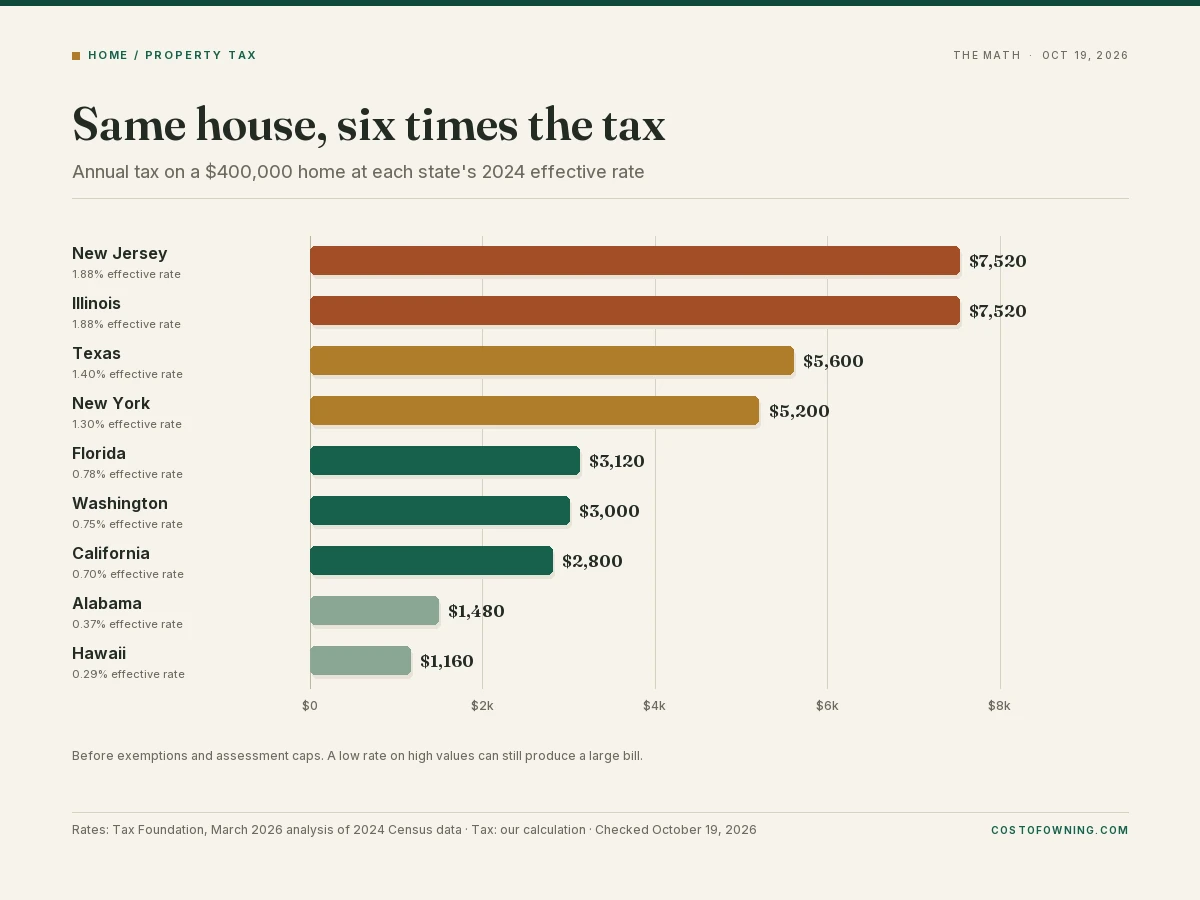
Real bills land above or below these figures, because exemptions and caps shift the taxable base. Texas cuts a $400,000 home’s school taxable value to $260,000 for 2026 via the $140,000 exemption, and California’s base-year cap means a long-time owner and a 2026 buyer can pay wildly different taxes on identical houses.
Fighting a bill you think is wrong
The number you can contest is the assessed value. Pull your assessment record and check the basics: square footage, lot size, bedroom count, and any exemptions you filed.
Then gather evidence: recent sales of similar homes nearby, your assessed value against neighbors with comparable houses, and photos when the record claims improvements that do not exist. Deadlines vary by state and county: Texas protests generally run to May 15 or 30 days after the notice, and Florida gives 25 days from the TRIM notice, so confirm your own date.
An appeal cannot lower the millage, which local budgets set, and it cannot change your neighbor’s bill or an exemption you do not qualify for; it changes assessed value. Run the numbers first: cutting $20,000 of assessment at 30 mills saves $600 a year, while shaving $2,000 saves $60 and may not justify the paperwork. Some owners hire a licensed appraiser or contingency agent instead; ask who they represent.
SALT and the limits that apply to itemizers
If you itemize, the state and local tax deduction is capped at $40,400 for 2026, up from $40,000, with a phase-down for filers above roughly $505,000 of income and a $10,000 floor. Most take the standard deduction, in which case property taxes deliver no federal subsidy.
Record property taxes, maintenance and insurance separately when preparing an ownership budget. Nothing here is tax advice, so confirm your case with a tax professional.
FAQ
Is the state effective rate a good estimate of my bill? No. It compares aggregate taxes with aggregate values, and your home has its own assessment, exemptions, and millage. Use it to compare places, then check your county’s millage and assessment ratio.
Which state has the highest property taxes? By both metrics here, New Jersey: the top rate (1.88%) and the top median bill ($9,590). Hawaii has the lowest rate (0.29%), and Alabama the lowest median bill ($788).
Can I appeal my property tax bill? You can appeal the assessed value. Deadlines typically run 25 to 90 days from the valuation notice, and local rules control. A win lowers assessed value, not the tax rate.
Does the SALT deduction still help me? Only if you itemize. The 2026 cap is $40,400, with a phase-down above roughly $505,000 of income and a $10,000 floor. Confirm with a tax professional.