
A more efficient appliance saves electricity. That does not automatically mean its higher price pays back during your ownership. The answer depends on the price premium, the difference in annual energy use, your electricity rate and the number of years you keep it.
Here is a comparison you can reproduce. Every product price, kWh figure, service cost and repair allowance below is hypothetical. We are not reviewing two real models or claiming to have measured their performance. The point is to put a useful ceiling on the premium you might pay before you go shopping.
Compare the same service first
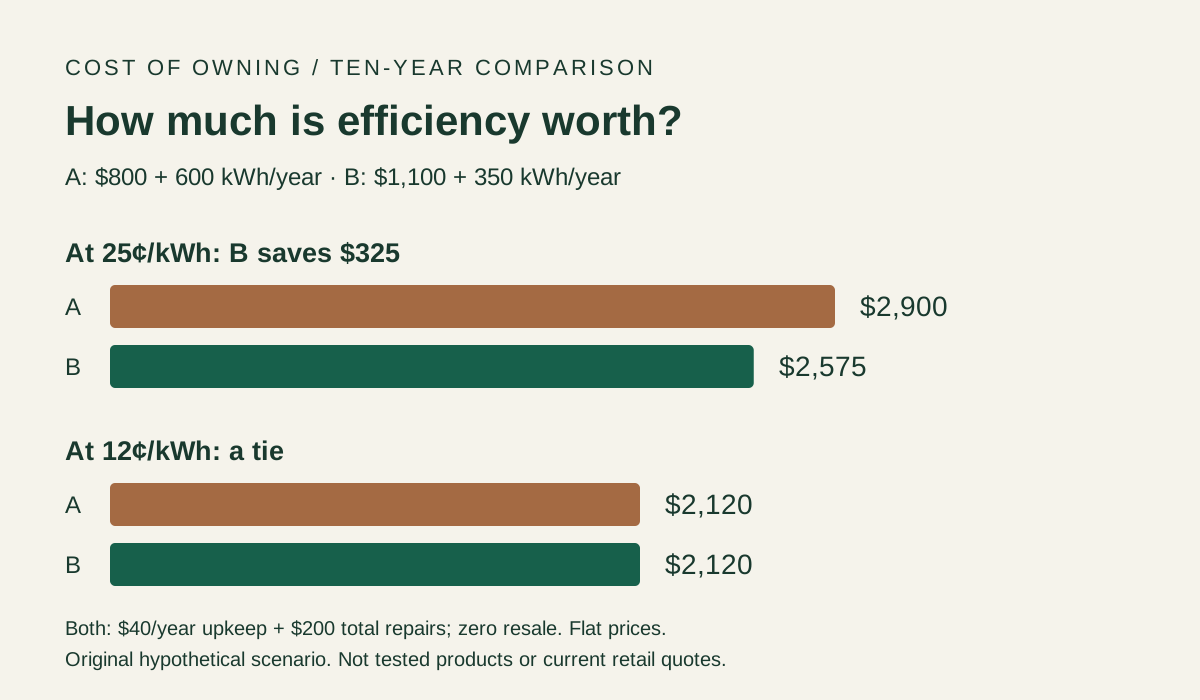
Our example assumes two appliances provide comparable capacity, features and service. Option A costs $800 installed and uses 600 kWh a year. Option B costs $1,100 installed and uses 350 kWh a year. B’s premium is $300, and its energy advantage is 250 kWh per year.
Both have an assumed $40 annual allowance for upkeep, $200 of repairs over the whole ten-year period, no subscription and zero resale value. We use the same allowances to isolate efficiency; this does not establish that two real machines have identical reliability.
You can enter the example, then your own quotes, in our ownership cost comparison calculator. Use the same horizon for both choices. A compact refrigerator and a full-size family model are different purchases even if one has a much smaller electricity number.
Use the label’s kWh, not just its dollars
The FTC explains EnergyGuide labels and notes that their operating-cost estimate reflects standardized use and an average energy price. Your actual bill depends on local prices and use. For an electricity-only comparison, the annual kWh figure lets you apply one consistent local rate to both models.
Multiply annual kWh by dollars per kWh. At 25 cents, use $0.25, not 25. Option A’s 600 kWh costs $150 per year; B’s 350 kWh costs $87.50. B saves $62.50 annually under these assumptions.
Do not multiply a cycling appliance’s maximum nameplate wattage by 24 hours a day and treat that as measured consumption. For a refrigerator, the compressor switches on and off. An annual energy label or a suitable measured energy sample provides a different kind of input from peak electrical capacity.
Compare label values for the same model configuration and test basis. A lower annual kWh figure can reflect a smaller cabinet or fewer features as well as better efficiency. If a seller changes the model number, revisit the comparison.
Rebuild the ten-year totals
A’s ten-year energy bill is 10 × $150 = $1,500. Add $800 upfront, $400 of upkeep and the $200 repair allowance. Total ownership cost is $2,900.
B’s energy bill is 10 × $87.50 = $875. Add $1,100 upfront, the same $400 upkeep and $200 repairs. Total is $2,575. B is $325 cheaper over ten years, despite costing $300 more at the start.
This is a cash budget in flat prices. There is no inflation, discounting or financing. The total includes the purchase price once; it does not add depreciation again. Zero resale is a conservative assumption for this exercise, not a claim that all used appliances are worthless.
Monthly equivalents are about $24.17 for A and $21.46 for B. Those figures spread the total for comparison. They are not loan payments, monthly cash expenses, or the size of the electricity bill alone.
Find the rate at which the premium stops paying
At 12 cents/kWh, A’s ten-year energy use costs $720 and B’s costs $420. Their $300 energy difference exactly equals B’s $300 purchase premium. With the same upkeep and repairs, both totals are $2,120.
The break-even rate follows directly:
Premium ÷ (annual kWh difference × years) = $300 ÷ (250 × 10) = $0.12/kWh.
Below 12 cents, the energy savings alone do not recover the premium over ten years. Above 12 cents, they do, under this flat-price scenario. At 25 cents, simple energy-only payback is $300 ÷ $62.50 = 4.8 years.
At a five-year holding period, the rate threshold doubles to 24 cents/kWh. At 25 cents over five years, B’s energy advantage is $312.50 and its net advantage after the premium is only $12.50. A small difference in installation or repair costs can outweigh that.
Put a ceiling on the premium
Reverse the calculation before shopping. With ten years, a 250-kWh annual difference and a 25-cent rate, total undiscounted energy savings are $625. That is the maximum extra upfront price justified by electricity savings alone if every other cost is equal.
Paying a $300 premium leaves $325 of headroom. If B needs $400 more in repairs than A over the period, that headroom disappears and B becomes $75 more expensive. Reliability assumptions can therefore matter more than another small efficiency improvement.
Do not turn that example into a claim that the efficient machine is less reliable. We have no failure-rate dataset for these hypothetical models. Treat it as a sensitivity test: how much additional repair cost would reverse your decision?
Financing also uses that headroom. If you borrow the premium, include the additional interest and fees. A promotion’s required service plan can change the recurring bill. Put mandatory fees into the comparison even if they are absent from the advertised product price.
Distinguish replacement from early replacement
This example compares two new purchases when you already need an appliance. Replacing a working appliance early asks a different question. The whole new installed cost, disposal, remaining useful life of the old machine and any later replacement must be compared over a common period.
A ten-year budget for a new appliance is not fairly compared with two years of repairing the old one. If the old appliance lasts two more years and then needs replacement, include that replacement on the repair path too. Our refrigerator repair guide and dishwasher repair guide cover the repair decision’s scope and inspection questions.
A shopping worksheet that stays useful
Record the exact model numbers, installed prices, annual label kWh, electricity price, planned holding period and included warranty terms. Then separate ongoing consumables from one-time allowances. Filters that cost $40 each year belong in recurring upkeep, while one $200 repair allowance belongs in the one-time field.
Run your base case, a shorter holding period and an extra-repair case. Save the figures with the date and the source of each input. The result will be more useful than a general claim that a product is cheap or efficient. Our appliance electricity guide explains running-cost categories, and our methodology explains why scenarios are not observed market averages.
FAQ
Is the efficient option always the better purchase?
No. Efficiency changes operating cost. Purchase price, capacity, repairability, installation, warranty and how long you keep it also affect the decision.
Does this include gas, water or detergent savings?
No. This example isolates electricity. Add those costs to the appropriate upkeep budget when they differ, and document how they were calculated. Do not assume electricity labels establish water or gas consumption.
Where did the example prices come from?
They were chosen for this original arithmetic exercise. They are not current market quotes or product recommendations. The FTC source explains how to interpret labels; it does not supply our example models. Source checked October 21, 2026.