
An 8,000-kWh solar system does not automatically erase 8,000 kWh of retail electricity spending. In our example below, the same production is worth $2,000 a year with full retail export credits and $1,040 with a lower export rate. Neither number is a national average. They show why the export rule on your utility tariff can matter more than another small discount on the panels.
This is a useful question to ask before buying solar in 2026. EnergySage’s latest marketplace report says self-reported homeowner interest in batteries reached 76% in the first half of 2026. That describes its marketplace, rather than all US homeowners. Our examples explain the economics behind that interest without assuming a battery pays for itself.
Two Prices for the Same Electricity
Solar electricity used immediately in your home avoids buying power. Solar electricity sent to the grid receives whatever compensation the utility contract allows. Those are separate values.
Under retail net metering, eligible exported energy can receive a credit based on the retail price. Under net billing, imports and exports are valued separately, and exports may receive a lower price. The terminology and details differ by utility. Annual settlement, time windows, credit expiry and charges that cannot be offset can all change the result.
California provides a concrete example. The California Public Utilities Commission says its Solar Billing Plan generally values exports below retail rates, although export values can exceed retail during certain late-summer evenings. Its explanation covers PG&E, SCE and SDG&E, rather than every California electricity provider. Do not apply that tariff to a municipal utility or another state.
A Worked Annual Savings Example
Assume the following inputs, chosen to show the calculation rather than represent a specific home:
| Input | Example assumption |
|---|---|
| Annual solar production | 8,000 kWh |
| Used in the home while generated | 40%, or 3,200 kWh |
| Exported | 60%, or 4,800 kWh |
| Avoided import price | $0.25/kWh |
| Lower export price | $0.05/kWh |
| Cash system cost after any verified rebate | $18,000 |
With retail credits, annual energy value is 8,000 × $0.25 = $2,000, assuming every generated kWh either avoids an import or receives a usable retail credit. Simple payback is $18,000 ÷ $2,000 = 9 years.
With the lower export price, value is (3,200 × $0.25) + (4,800 × $0.05) = $1,040. Simple payback becomes 17.3 years. Both cases isolate energy value and exclude fixed charges. The retail-credit example also assumes the household can use all those credits under its settlement rules.
These calculations exclude financing, maintenance, degradation, rate changes and taxes. Our solar installation cost guide helps price the equipment side. A contractor’s financial projection should explain those omitted costs, rather than bury them inside a savings figure.
Timing Changes the Result
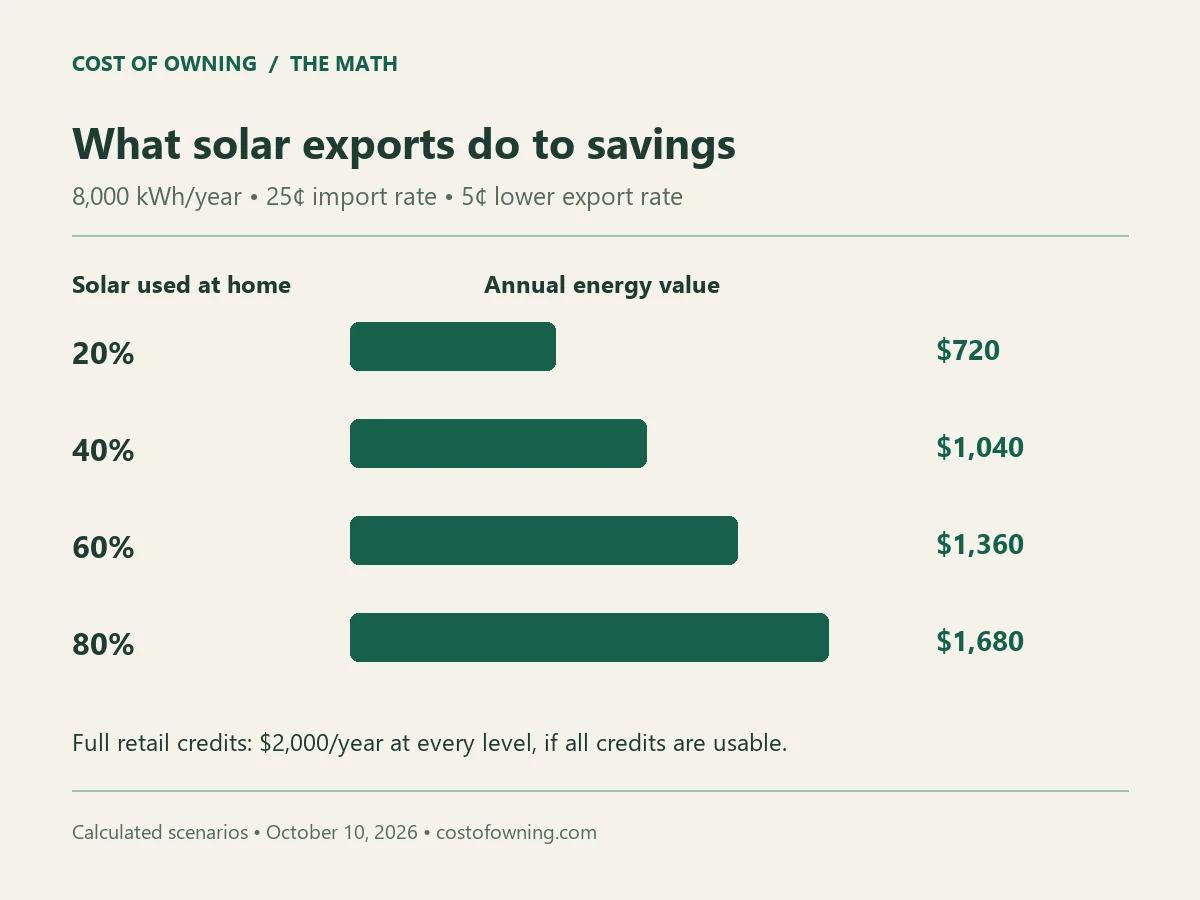
Under the lower-export scenario, increasing self-consumption raises the value of the same panels:
| Solar used immediately at home | Used at home | Exported | Annual energy value |
|---|---|---|---|
| 20% | 1,600 kWh | 6,400 kWh | $720 |
| 40% | 3,200 kWh | 4,800 kWh | $1,040 |
| 60% | 4,800 kWh | 3,200 kWh | $1,360 |
| 80% | 6,400 kWh | 1,600 kWh | $1,680 |
Moving 1,000 kWh from exports to direct use adds $200 under these assumptions: 1,000 × ($0.25 − $0.05). Scheduling a dishwasher, water heater or EV charge while panels produce can improve self-consumption if the appliance and tariff allow it. It does not create extra solar production.
For time-of-use plans, calculate avoided purchases at the price applying when the electricity would otherwise be bought. A flat 25-cent annual average cannot capture a costly evening peak or a cheap overnight EV rate. Ask for a calculation using hourly or interval data if the quote promises precise time-of-use savings.
Does a Battery Close the Gap?
A battery moves energy to a later hour, with losses. Suppose it charges from 2,000 kWh of solar that would otherwise be exported. At an assumed 90% round-trip efficiency, it returns 1,800 kWh to the home.
At our example prices, avoided imports are worth $450, while the exports given up were worth $100. The battery adds $350 a year of energy value before operating costs. If the incremental installed battery cost is an assumed $8,000, simple payback on that benefit alone is 22.9 years.
Change the avoided evening price to an assumed 40 cents and the added value becomes $720 − $100 = $620, for 12.9 years of simple payback. These are scenario results, not battery quotes or utility rates. They show why a battery’s savings calculation needs both the import price and the export opportunity cost.
Backup protection has a separate value to the household. It is reasonable to pay for that, but do not describe it as utility-bill savings. Our solar battery cost guide covers the installation questions. Confirm whether the proposed system actually supports backup operation and which circuits it can power.
What to Request Before Signing
Get the tariff name and an estimate that separates production, direct use, exports and battery losses. Ask whether credits roll forward, expire, or settle at a different year-end price. Ask which fixed charges, minimum bills and other fees remain even when annual generation matches usage.
If you already have solar, check the effect of changing equipment before adding capacity or switching tariffs. The rules for an existing system may differ from a new application. CPUC’s published comparison distinguishes older net-metering arrangements from the Solar Billing Plan; your utility must confirm the rules for your particular account.
Also request the cash price separately from the financed price. A low monthly payment does not tell you whether dealer fees or interest offset the savings. Our solar lease versus buy guide explains why payments and ownership deserve their own comparison.
Use Your Quote’s Numbers
The basic formula is directly used kWh × avoided import rate + exported kWh × usable export rate. Subtract recurring charges and costs that belong in the comparison. For a battery, subtract the export value sacrificed to charge it.
Our solar payback calculator is a starting estimate. If it treats all production at the retail rate, that result is an upper-bound energy-value scenario unless your exports really receive usable retail credits. Calculate the export portion separately before relying on it for a purchase.
FAQ
Is net billing the same as net metering?
No. Net billing values imported and exported electricity separately. Retail net metering may credit eligible exports at retail-related rates. The actual contract controls, including charges that credits cannot cover.
Do solar panels still save money with low export credits?
They can, especially when your home uses much of the production directly. In our assumed 25-cent import and 5-cent export scenario, each kWh used at home has five times the energy value of a kWh exported.
Should every solar owner buy a battery?
No. Compare incremental installed cost with the extra annual benefit after losses and forgone export credits. Backup capability may justify a purchase even when bill savings alone do not.
Can a solar system eliminate my entire bill?
Do not assume that. Fixed charges, non-offsettable fees, seasonal imports and settlement rules can leave a bill even if annual solar production equals annual consumption.