
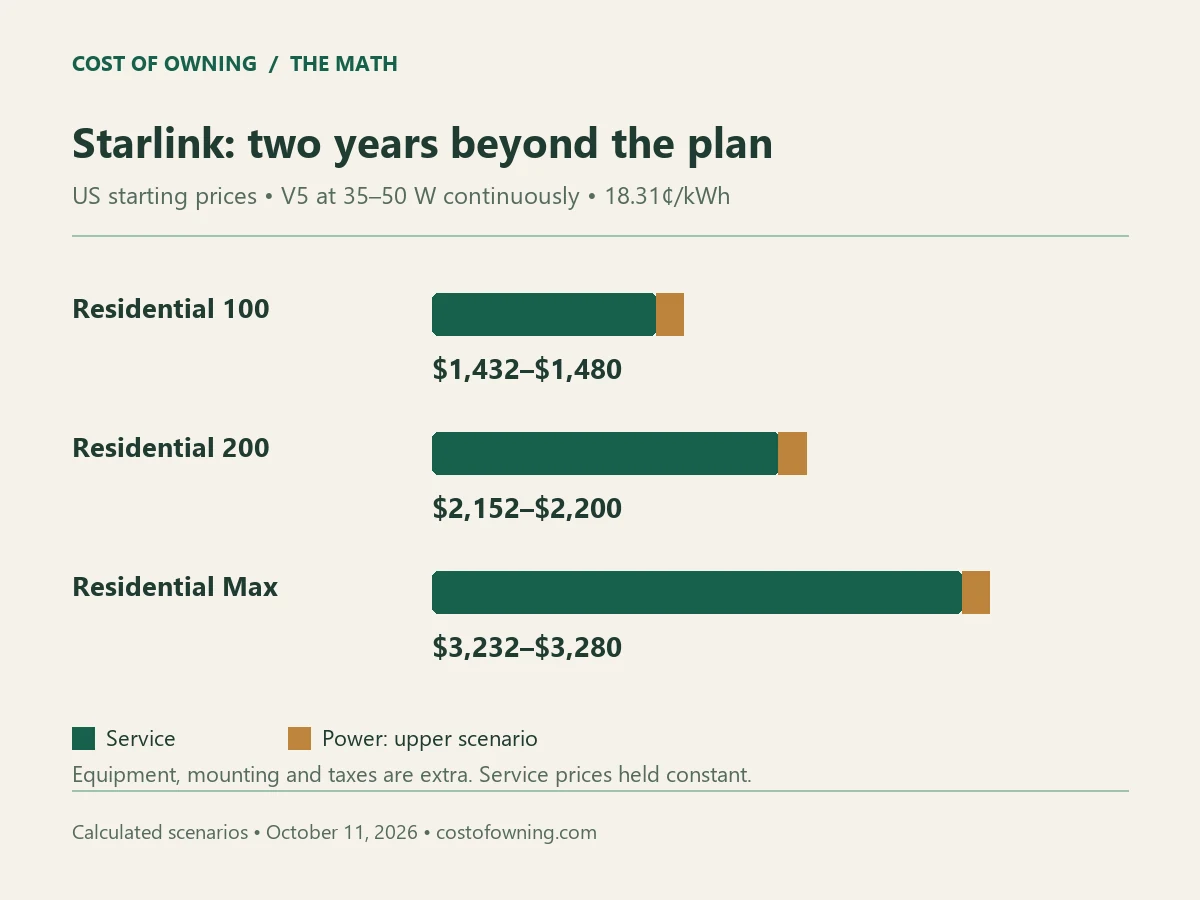
Starlink’s US residential service starts at $55 a month as of October 11, 2026. Keeping a V5 kit powered continuously adds about $4.61 to $6.59 in a 30-day month at the national electricity rate used here. Over two years, the entry plan plus that modeled electricity costs $1,432 to $1,480, before hardware, installation extras, taxes and other charges. Those totals are our calculations, not an address-specific Starlink quote.
The newer V5 hardware makes the power bill smaller than for a V4 kit. The much bigger decisions remain your monthly tier and the equipment offer at your address. Our home internet provider comparison covers cable, fiber and cellular alternatives; this guide looks more closely at satellite ownership costs.
The Current US Residential Plans
The Starlink US page, checked October 11, lists the following starting prices. The 100 and 200 Mbps tiers have download caps at their named speeds and are offered only in select areas. Max has the highest residential network priority, with advertised speeds up to 400+ Mbps. Speeds are maximums, rather than guarantees, and congestion can reduce them.
| Residential tier | Starting monthly service | Service alone, 12 months | Service alone, 24 months |
|---|---|---|---|
| 100 Mbps | $55 | $660 | $1,320 |
| 200 Mbps | $85 | $1,020 | $2,040 |
| Max | $130 | $1,560 | $3,120 |
The page advertises professional home installation for the 200 Mbps and Max tiers. Max also offers an optional additional Mini kit with discounted Roam service. Treat any travel subscription as a separate expense and confirm the eligibility and checkout terms.
Choosing 200 instead of 100 adds $720 over two years. Choosing Max instead of 100 adds $1,800. Start with the tier that fits actual household use, then revisit it if congestion or simultaneous downloads become a problem. A faster subscription will not solve weak Wi-Fi in a distant room; our mesh Wi-Fi versus router cost guide addresses that expense separately.
V5 Versus V4 Electricity Cost
Starlink now highlights the V5 kit on its US page, with availability in select areas. The official V5 specification sheet gives average consumption of 35 to 50 W. The Standard 4 X specification sheet gives 75 to 100 W for that older hardware. These figures are planning inputs, not measurements from our own house.
We multiply the published range by continuous uptime. Starlink’s power guidance describes its power specifications as AC-input averages including the supplied router, power supply and cables. We use the V5 sheet’s newer range for that kit. The rate is 18.31 cents per kWh, the US residential average in EIA’s July 2026 Electric Power Monthly, which remains the latest release when checked October 11.
| Hardware and assumed average draw | Energy, 30 days | Cost, 30 days | Cost, 365 days |
|---|---|---|---|
| V5, 35 W | 25.2 kWh | $4.61 | $56.14 |
| V5, 50 W | 36.0 kWh | $6.59 | $80.20 |
| Standard 4 X, 75 W | 54.0 kWh | $9.89 | $120.30 |
| Standard 4 X, 100 W | 72.0 kWh | $13.18 | $160.40 |
Formula: watts ÷ 1,000 × hours powered × dollars per kWh. A year uses 8,760 hours; a 30-day month uses 720. Consequently, twelve of those illustrative months are shorter than a calendar year. Snow melting, activity and installation conditions can change consumption. Measure the complete system at its outlet for a household-specific figure, and include any extra mesh nodes separately.
What Two Years Actually Add Up To
Using 17,520 hours for two 365-day years, V5 electricity adds $112.28 to $160.40. Hold the service price constant over the whole period and the result is:
| Tier | Service plus modeled V5 electricity | With an assumed $400 in upfront extras |
|---|---|---|
| Residential 100 | $1,432–$1,480 | $1,832–$1,880 |
| Residential 200 | $2,152–$2,200 | $2,552–$2,600 |
| Max | $3,232–$3,280 | $3,632–$3,680 |
The $400 is a hypothetical combined allowance, not a verified kit or installation price. Replace it with the equipment, mounting and shipping total offered at your address. We could verify the public service tiers, but the public page did not give us a universal hardware purchase or rental charge. A precise nationwide all-in price would therefore be misleading.
Build your own total as upfront charges + monthly service × months + rental charges × months + electricity + taxes + other required fees. Do not count a rental fee again if your checkout already includes it in a combined monthly price. Price changes during the period would also change these totals.
Buying Versus Renting the Kit
If checkout gives you both options, compare the purchase price with the recurring rental charge. For example, an assumed $300 purchase versus $12 a month rental crosses at 25 months. At 24 months, rental would cost $288; at 36 months it would cost $432. These deliberately round figures demonstrate the calculation and are not current Starlink offers.
Ownership can also change replacement responsibility, return requirements and cancellation costs. Read the terms attached to the actual offer. A short stay or uncertain address favors a different calculation from a five-year home installation. Include a one-time rental setup charge if there is one, and do not assume payments toward rental later become purchase credit.
The Installation Costs to Ask About
Before ordering, check the sky view with Starlink’s app and decide where the cable will enter the house. The V5 specifications list a 15-meter Starlink cable and a pipe adapter in the kit. A mounting location farther away may require different accessories or additional work.
Ask what the advertised installation includes: roof versus wall mounting, drilling and weather sealing, a difficult cable route, and any extra height or obstruction work. Request an itemized price for anything outside that scope. Removing trees or arranging a tall mount can dominate the upfront bill; a service-tier comparison cannot capture those site-specific costs.
For an outage-prone home, budget backup power separately. Our portable power station guide explains why battery capacity and device watts determine runtime. As a simple example, 850 Wh of usable output would supply an assumed steady 50 W load for 17 hours, or 100 W for 8.5 hours. Actual output losses and other connected equipment reduce runtime. A battery backup does not remove the need for a clear sky view.
Should a V4 Owner Upgrade for Lower Power Use?
Compare the cost of changing hardware with your measured energy saving. In a hypothetical change from 85 W to 45 W, the 40 W reduction saves 350.4 kWh, or $64.16 a year at 18.31 cents. An assumed $300 net upgrade cost would take about 4.7 years to recover through electricity alone.
That calculation gives a reason to keep a working kit when the upgrade cost is high. Starlink’s V4-versus-V5 comparison lists peak hardware speeds of 400+ Mbps and 375+ Mbps respectively, so lower power does not mean a higher advertised speed. Off-grid users may value the smaller continuous load because it also affects battery and solar sizing. Check the offered hardware, mounting compatibility and service eligibility before treating the V5 power range as your next bill.
FAQ
How much does Starlink cost per month in 2026?
The US page checked October 11 lists residential service starting at $55, $85 and $130. Add your address-specific equipment charges, taxes and electricity. Our continuous V5 example adds $4.61 to $6.59 for a 30-day month.
Does V5 use less electricity than V4?
The official V5 average range is 35 to 50 W, compared with 75 to 100 W for Standard 4 X. At continuous uptime and 18.31 cents per kWh, our annual calculations are about $56 to $80 and $120 to $160 respectively.
Is professional installation included in every plan?
The current US page advertises it for Residential 200 and Max. Confirm availability, included work and any extra charges on the actual offer before booking.
Are these two-year prices guaranteed?
No. They hold today’s starting monthly prices constant for comparison and exclude address-specific fees unless explicitly modeled. Your checkout offer and later service changes determine what you pay.