
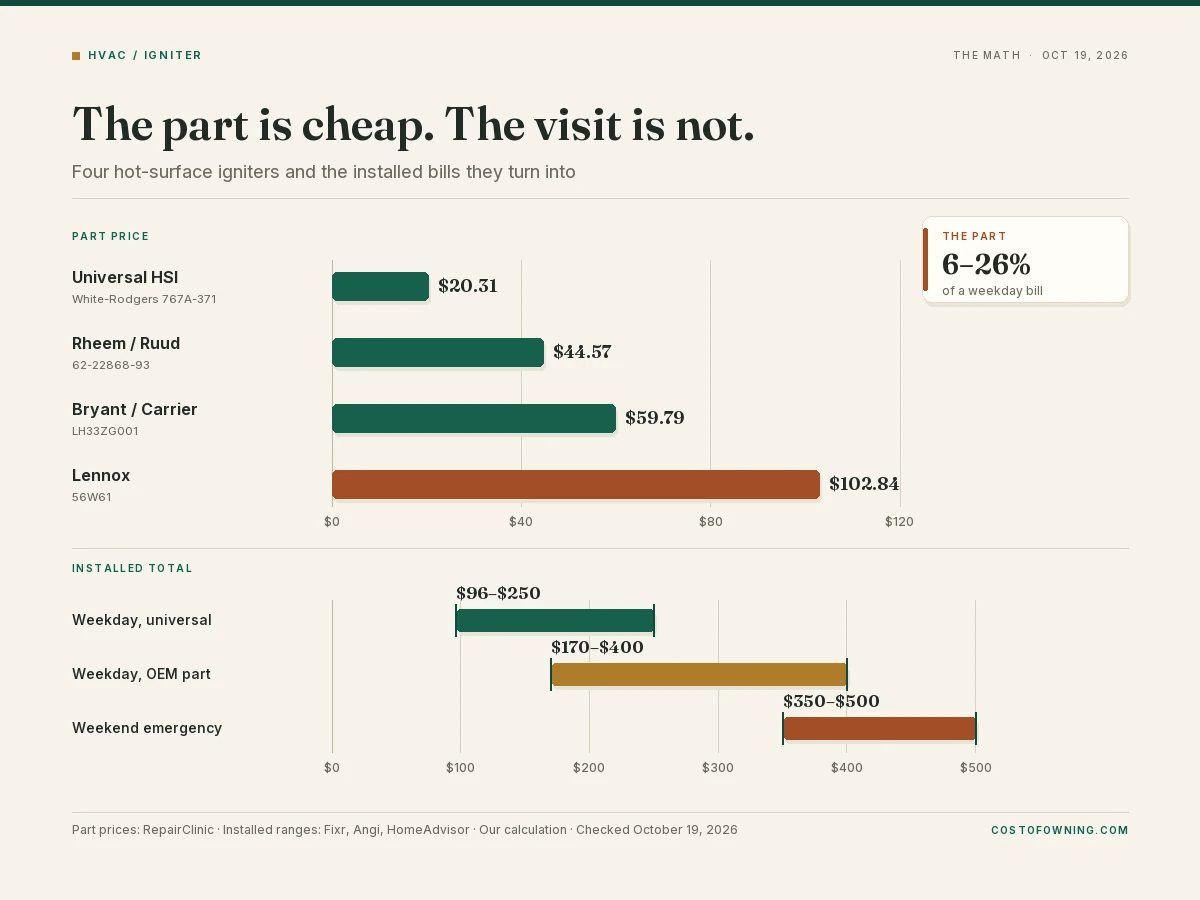
A furnace igniter is a small part with a real service bill. Hot surface igniters for the major brands run $44.57 to $102.84 at RepairClinic, and a universal replacement is $20.31 (checked October 19, 2026). Installed, a straightforward replacement lands at $96 to $178 per Fixr and $150 to $250 per Angi, with weekend emergencies at $350 to $500 (checked October 19, 2026). One caution before you approve an igniter: a no-heat furnace often has a different culprit, and the cheapest one is a filter.
Below: part prices by brand, what the visit adds, how the ignition systems differ, and which no-heat symptoms point at the igniter.
What an Igniter Costs as a Part
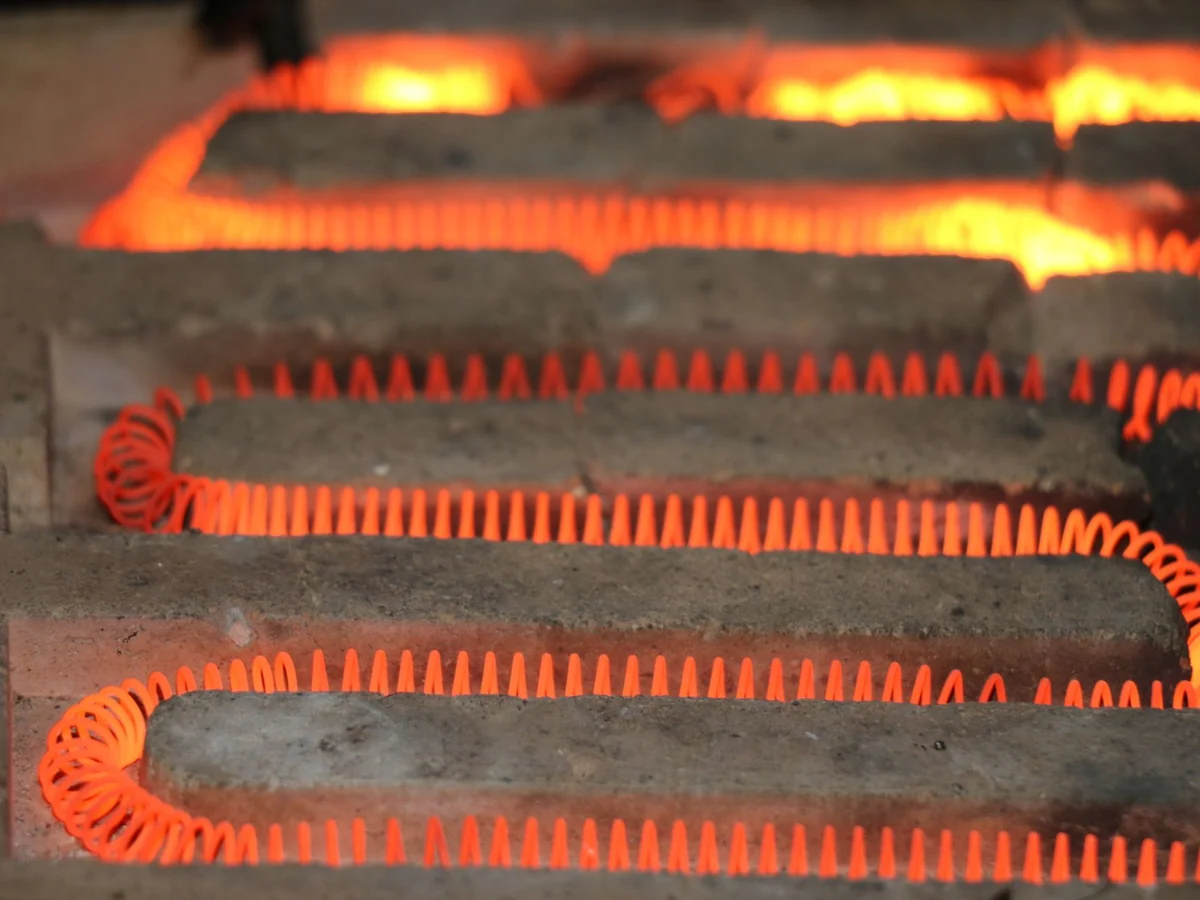
The igniter lights the gas. Most furnaces built this century use a hot surface igniter (HSI), a ceramic element that glows orange and lights the burners directly.
| Igniter | Part number | Price | Source (checked October 19, 2026) |
|---|---|---|---|
| Universal HSI | White-Rodgers 767A-371 | $20.31 | RepairClinic |
| Rheem and Ruud | 62-22868-93 | $44.57 | RepairClinic |
| Bryant and Carrier | LH33ZG001 | $59.79 | RepairClinic |
| Lennox | 56W61 | $102.84 | RepairClinic |
A universal igniter can save $40 to $80 against the branded parts above (our calculation), but it may need a mounting adapter and can carry a shorter warranty. On a furnace still under warranty, an OEM match is safer.
What the Repair Costs Installed
Angi puts a daytime igniter replacement at $150 to $250 and an emergency visit at $350 to $500, with labor of $50 to $150 per hour, and $150 to $215 after hours (checked October 19, 2026). Fixr prices the job at $96 to $178 including the call and the part. HomeAdvisor spreads the repair from $150 to $500 (checked October 19, 2026).
| Scenario | Part | Labor and visit | Total (our calculation) |
|---|---|---|---|
| Weekday, universal igniter | $20.31 | $125 - $300 (trip $75 - $150 + 1 hour at $50 - $150) | $145 - $320 |
| Weekday, OEM igniter | $44.57 - $102.84 | Same | $170 - $400 |
| Weekend emergency | $44.57 - $102.84 | Angi’s figure for the full emergency job | $350 - $500 |
Rows one and two are our calculation; the emergency row is Angi’s published range.
Compare the diagnosed igniter repair with a written replacement quote and the condition of the rest of the system. Our furnace repair cost guide covers other common failure categories.
Hot Surface vs. Spark Ignition
The ignition sequence drives the diagnosis. On a typical furnace: the inducer fan starts, a pressure switch confirms the flue is clear, the igniter heats up, the gas valve opens, the flame sensor proves flame, and the blower starts. Trouble before the igniter stage stops the sequence before the element ever glows.
- Hot surface ignition. A silicon nitride or silicon carbide element heats until it glows and lights the gas directly. The element is ceramic and brittle, so handling damage and voltage spikes are common failure causes, and a hairline crack can stay invisible until the next call for heat.
- Spark ignition. Older furnaces arc a spark across a gap, like a gas range; these often respond to cleaning and gap adjustment, which is still burner work for a technician.
- Condensing (90%+ AFUE) furnaces. A clogged condensate drain or blocked intake can stop the sequence early and look like an ignition failure.
When No Heat Is Not the Igniter
Angi’s furnace repair data puts a flame sensor at $150 to $250, a gas valve at $200 to $600, a draft inducer at $200 to $1,500, and a blower motor at $150 to $2,000, with filters at $1 to $35 (checked October 19, 2026). Fixr prices a flame sensor repair at $68 to $127, a limit switch at $66 to $122, and a control board at $390 to $725.
| Symptom | Usual suspects | Typical repair |
|---|---|---|
| Igniter glows, but no flame appears | gas valve, gas supply, pressure switch | $200 - $600 |
| Lights, then quits after a few seconds | flame sensor, dirty filter, blocked flue | $68 - $250 |
| Short cycles, house never warms | limit switch, clogged filter, blower motor | $66 - $2,000 |
| No glow, fault code on the board | control board, igniter | $390 - $725 |
An igniter that glows but never lights the gas is working; the fault is downstream at the gas valve or upstream at the pressure switch. A furnace that lights and quits seconds later is usually reporting a flame-sensing problem, not an ignition problem. And one row in that table costs under $35: change the filter first.
What Homeowners Can Safely Check
Filters, power, thermostat, and vents are fair game:
- The filter. A clogged $1 to $35 filter can trip the limit switch — a common “furnace is broken” call that costs almost nothing.
- Power and thermostat. Check the toggle switch and breaker, plus thermostat batteries and mode; Angi lists thermostat replacement at $100 to $600 if it has failed.
- Intake and exhaust vents. On high-efficiency furnaces these are the two PVC pipes outside. Keep them clear of snow, ice, and leaves; a blocked intake stops the sequence.
- Carbon monoxide alarms. The EPA’s indoor air quality guidance warns that CO is odorless and that fuel-burning appliances are a leading indoor source; test alarms on every level.
Stop points, and they matter more than the checklist:
- Gas smell. Leave the house and call the gas utility’s emergency line from outside. Do not call an HVAC company first and do not flip switches on the way out.
- Repeated lockouts. Resetting once after a power blip is reasonable. A furnace that locks out twice in a week is flagging a failing sequence, so book service instead of resetting a third time.
- Anything inside the burner cabinet. Watching a glow cycle means opening the door, and swapping the element means handling brittle ceramic near gas burners. Many jurisdictions require a licensed contractor for gas appliance work, and a cracked replacement igniter fails at the next call for heat.
- A cracked heat exchanger. If a technician finds one, it can let combustion gases into the air you breathe, and the repair often costs more than a new furnace.
Ask a service provider which ignition, flame-sensing and filter checks are included in a maintenance visit, and request a written price for that scope.
Bottom Line
Plan on $96 to $250 for a plain igniter replacement, $350 to $500 on a weekend emergency, and $20.31 to $102.84 for the part itself. Ask the technician what they observed: an igniter that glows without flame, or a furnace that lights and quits, points elsewhere in the sequence. On a repair above $400 — or a furnace past 15 years — run the age-times-cost math with our HVAC repair or replace calculator before you commit.
FAQ
How much does a furnace igniter replacement cost?
Fixr’s all-in price is $96 to $178, Angi’s daytime range is $150 to $250, and emergency visits reach $350 to $500 (checked October 19, 2026). The part itself sells for $20.31 universal and $44.57 to $102.84 branded.
How do I know if my igniter is bad?
Confirming it means watching the ignition sequence with the burner cabinet open, which is a technician’s job. The signs are a furnace that runs its inducer but never lights, or a visibly cracked element. If the element glows but no flame follows, the igniter is working and the problem is elsewhere in the sequence.
Can I replace the igniter myself?
We do not recommend it. The element cracks easily during handling, the work happens inches from the gas valve and burners, and many jurisdictions treat gas appliance repairs as licensed work. A failed DIY attempt can also put the parts warranty at risk.
Why did my new igniter fail?
Common reasons are voltage spikes, age, and damage during installation. If a replacement fails within a season, have the technician check the control board and incoming power before installing another one.