
A failed run capacitor is one of the cheapest things that can stop an air conditioner, and one of the easiest repairs to overpay for. We found a 35 MFD run capacitor for $9.64 and a 45/5 µF dual-run capacitor for $14.64 at US parts distributors, both checked October 19, 2026. Installed, the same job runs $100 to $400 according to Fixr, while Angi reports $200 to $400 with a $250 average and notes the capacitor itself “rarely exceeds $45” (checked October 19, 2026).
The gap between a $15 part and a $250 bill is the diagnosis, the truck, and the labor hour. Below: what each capacitor type costs, what the service visit adds, and why a capacitor that fails twice in one season is usually a symptom of something else.
What the Part Costs
A capacitor helps a motor start or keep running. Residential condensers use three types:
- Run capacitor. A single oval or round can, rated in microfarads (µF) and volts, that feeds one motor.
- Dual-run capacitor. Two capacitors in one can, printed like 45/5, feeding the compressor and fan.
- Start capacitor. A higher-µF part that gives the compressor an extra boost at startup, often wired with a resistor.
| Type | Example spec | Price | Source (checked October 19, 2026) |
|---|---|---|---|
| Run capacitor | 35 MFD oval, 440V | $9.64 | SupplyHouse |
| Dual-run capacitor | 45/5 µF round, 440V | $14.64 | RepairClinic |
| Start capacitor | 161-193 µF, 220-250V | $15.97 | TEMCo |
Angi’s part data lines up: $8 to $30 for a run capacitor, with dual-run types about $20 more. What matters is the match — the µF value has to fit the motor, and the voltage rating should meet or beat the old can. A wrong-rating part is a common reason a fresh capacitor dies early.
What the Service Visit Adds
Fixr lists labor at $60 to $150 per hour, a $75 to $250 diagnostic fee, and emergency surcharges of $50 to $200 or more (checked October 19, 2026). Angi’s job total is $200 to $400 with a $250 average, spread from $60 to $600 by market.
| Source | Installed range | Typical | Notes |
|---|---|---|---|
| Fixr | $100 - $400 | $175 | Labor $60 - $150/hr; diagnostic $75 - $250 |
| Angi | $200 - $400 | $250 | Full spread $60 - $600; weekend calls cost extra |
Three Visits, Three Bills
The part never decides the bill. Here is the same repair in three timing scenarios, stacking published fees on published part prices.
| Scenario | Part | Fees | Total (our calculation) |
|---|---|---|---|
| Swapped during a fall tune-up | $9.64 - $14.64 | $90 - $220 tune-up visit | $100 - $235 |
| Weekday service call, one labor hour | $9.64 - $14.64 | $75 - $250 diagnostic + $60 - $150 labor | $145 - $415 |
| Weekend emergency call | $9.64 - $14.64 | $100 - $250 visit + $50 - $200 surcharge + labor | $220 - $615 |
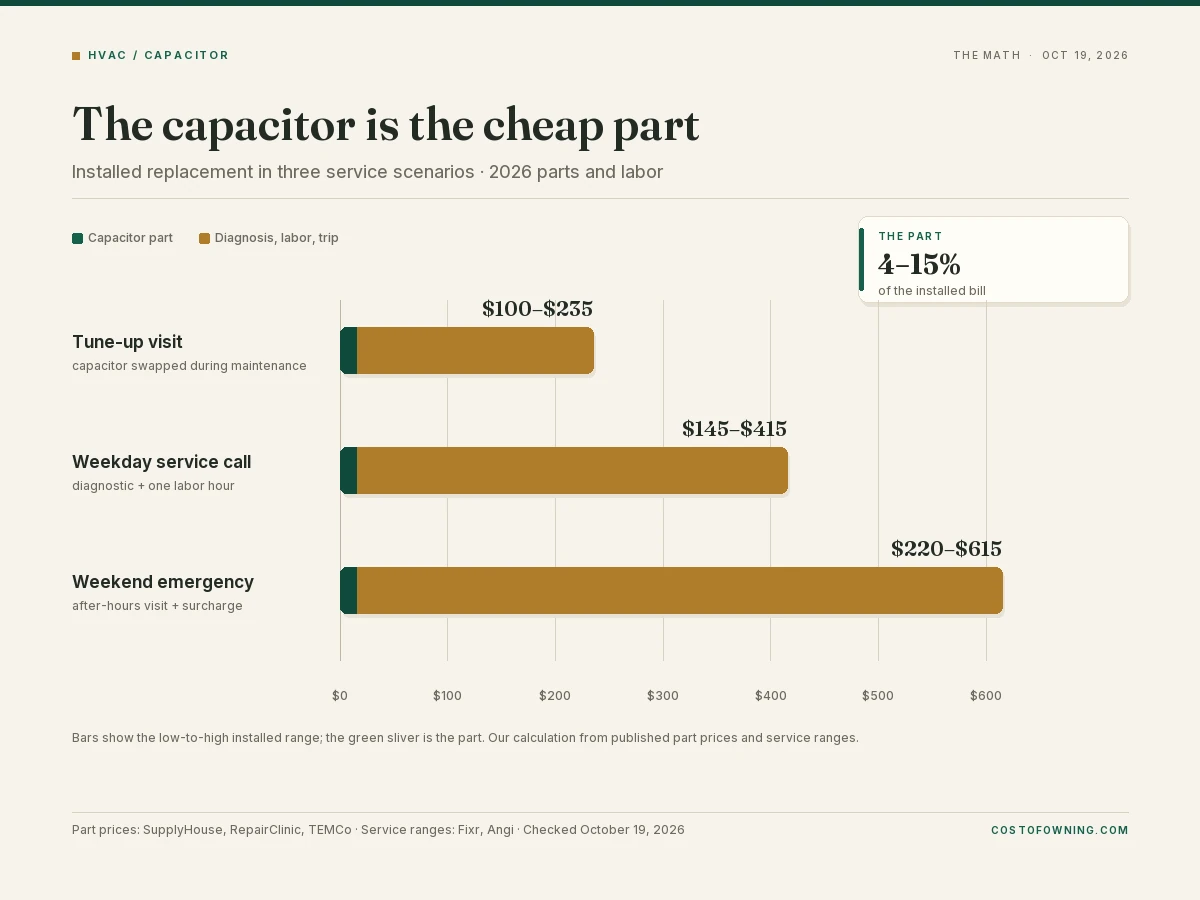
The tune-up row is the cheapest version of this repair, and it catches a weak capacitor before a hot afternoon.
Compare the diagnosed repair with an itemized replacement quote for your system. Our HVAC repair or replace calculator lets you test the costs and remaining-life assumptions; the comparison does not establish how long either option will last.
Why Capacitors Fail, and Why They Fail Again
Capacitors live in the hottest corner of the machine, inches from the compressor, and they run whenever the system does. Heat wears them out, so there is no single lifespan number: a shaded unit that runs two months a year and a roof-mounted one in a desert climate put very different hours on the same part.
Failure usually shows up in one of three ways: the can bulges or leaks, the measured capacitance drifts below the printed rating, or the unit hums and will not start. Plenty of dead capacitors look normal, so a meter reading is the only reliable test. The symptoms — a fan that never spins up, a compressor that hums and trips, a breaker that keeps tripping — overlap with contactor, motor, and refrigerant faults, so treat them as a reason to call, not a diagnosis.
When the same capacitor fails twice, the capacitor is rarely the story:
- A tired motor. Worn fan-motor bearings raise the current the motor draws, and that current cooks the capacitor. If a fan motor and capacitor fail within months, treat them as one repair.
- A spec mismatch. A wrong µF or voltage value from the last visit fails early, especially when a 370V part lands in a 440V circuit.
- Voltage events. Storms and utility spikes shorten capacitor life. In storm-prone areas, a whole-home surge protector is worth asking a licensed electrician about.
Why This Is Not a Homeowner Repair
Every capacitor in the condenser can hold a charge after the power is off. Virginia Tech’s environmental health and safety office states that capacitors “may store hazardous energy even after the equipment has been de-energized.” OSHA’s electrical standard for capacitor work requires disconnecting the capacitor from its power source, waiting at least five minutes, then short-circuiting it before anyone handles it.
So this guide stops short of a how-to on purpose. Two risks matter as much as the shock hazard:
- Looks are not a diagnosis. A capacitor that looks new can test far below its rating. Replacing a part on appearance alone leads to a second service call.
- The rating has to match, and the motors get checked. A wrong µF value strains the compressor, the most expensive component in the system, and a new capacitor says nothing about whether the motors it feeds still draw normal amps.
A licensed technician brings the meter, the matching parts, and the amp readings that confirm the repair. That is what the $100 to $400 buys, along with liability coverage and warranty-compliant work.
Bottom Line
Expect $100 to $400 for an installed capacitor, with a $175 average from Fixr and $250 from Angi, while the part itself runs $9.64 to $15.97 at the distributors we checked. It is almost always worth fixing — the repair is 1% to 7% of a new system (our calculation) — so get the part price, labor, and diagnostic fee as separate lines, and ask the technician to confirm fan and compressor amp draw. If two capacitors fail in one season, invest in the motor diagnosis, not a third capacitor.
FAQ
How much does AC capacitor replacement cost?
Fixr reports $100 to $400 with a $175 average, and Angi reports $200 to $400 with a $250 average (both checked October 19, 2026). The part alone sells for $9.64 to $15.97 at the distributors we checked, and a weekend emergency call can add a $50 to $200 surcharge and push the total past $600 (our calculation).
Can I replace an AC capacitor myself?
It is not a safe homeowner repair. The capacitor holds a charge after the disconnect is pulled; OSHA’s standard requires a disconnect, a five-minute wait, and a short circuit before the part is touched. Virginia Tech EHS notes the charge can remain after de-energizing, and the µF rating has to match to protect the compressor. DIY work can also complicate a parts warranty claim.
Why does my capacitor keep failing?
Usually because something else is wrong. A motor with worn bearings draws higher current, and the capacitor absorbs that stress until it fails. A previously installed part with the wrong µF or voltage rating fails early too. If two capacitors fail within a season, ask for a fan motor and compressor amp-draw check instead of a third part.
How long does an AC capacitor last?
Angi puts typical life at 10 to 20 years, but heat, run time, and the health of the motor it feeds change that picture — the same part works under harder conditions in a sun-baked cabinet than in a shaded, mild climate. That spread is why a spring tune-up is a reasonable way to catch a drifting capacitor early.