
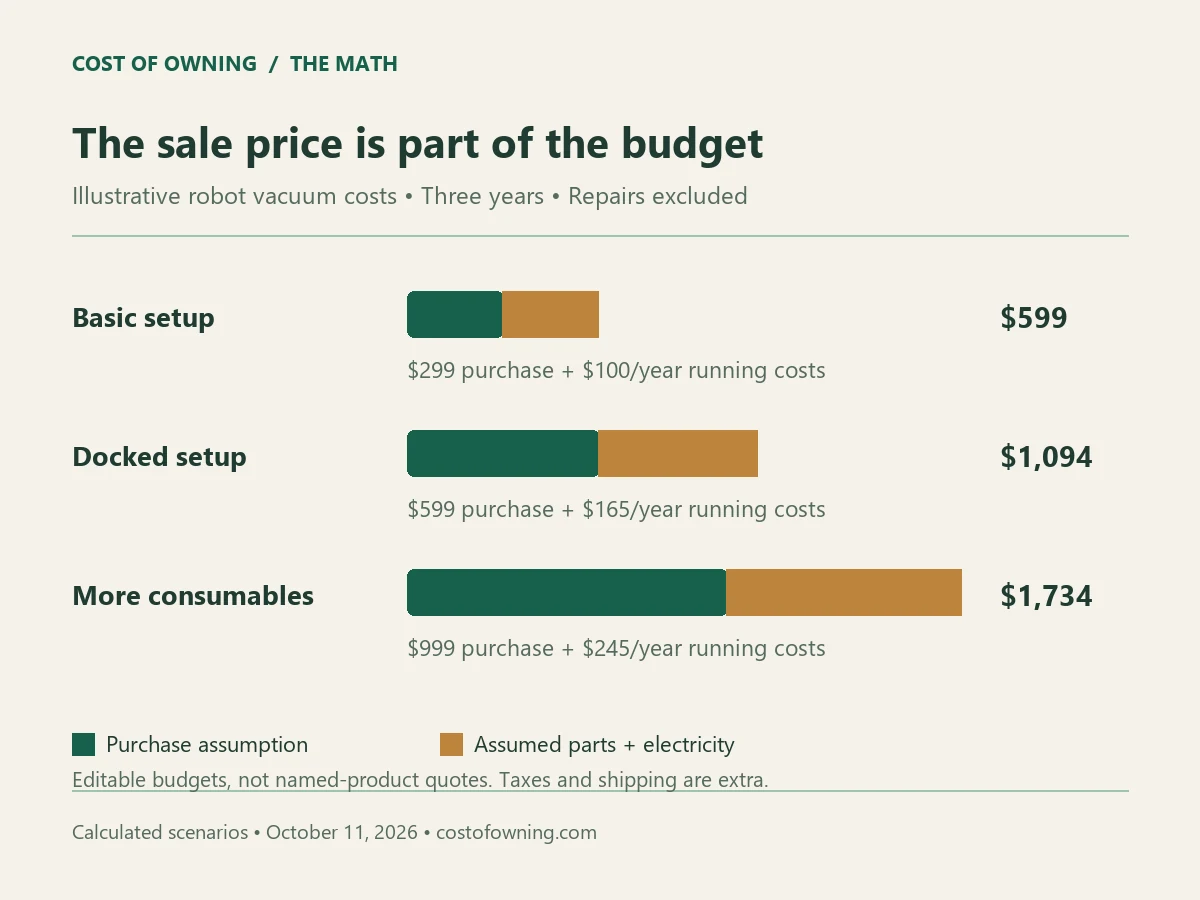
A robot vacuum’s ownership cost starts with the sale price and continues with bags, brushes, filters, mop pads, cleaning solution and electricity. In our illustrative budgets, a $299 basic purchase totals $599 over three years, a $599 docked model totals $1,094, and a $999 model with more consumables totals $1,734. Those examples use stated allowances rather than claim an average repair rate or rank actual products.
Roborock’s official US store is advertising its October sale when checked October 11, 2026. Discounts make this a useful time to compare running costs before ordering. The question is how much you will spend on the exact model you buy, and how much manual floor cleaning it realistically replaces. For the rest of the house, see our appliance electricity cost guide.
Price the Replacement Parts Before the Robot
Manufacturer accessories provide a concrete starting point. The Roborock US accessory store, checked October 11, lists a compatible two-piece side-brush pack at $15.99 and a main brush for specified Qrevo and other models at $22.99. Its separate six-pack dust-bag page lists $25.59, but displayed it as out of stock when checked.
| Accessory example | Posted pack price | Our unit-price calculation |
|---|---|---|
| Compatible Roborock dust bags, six | $25.59 | $4.27 per bag |
| Compatible side brushes, two | $15.99 | $8.00 per brush |
| Listed Qrevo-compatible main brush, one | $22.99 | $22.99 per brush |
As another reference, iRobot’s replenishment kit for specified e, i and j series and Combo i5/j5 models displayed $66.99 on its US listing when checked. That kit is an accessory-price example, not a statement that it supplies every part an owner needs for a year.
Compatibility is specific. Similar model names can use different rollers, filters and pad shapes. Match the complete model number and pack contents; a cheap bundle that does not fit has no useful unit price. Also compare delivery charges, since buying one small part at a time can cost more than its shelf price suggests.
Turn Packs Into an Annual Budget
For a compatible original Qrevo setup, suppose you use six bags, two side brushes and one main brush a year. Those quantities are assumptions, not a required schedule. At the listed prices, that partial basket costs $64.57 a year before shipping and tax. It still needs any filters, mop pads and cleaning solution you replace.
Doubling bags from six to twelve adds $25.59. A second main brush adds $22.99. Over three years, those two changes alone add $145.74 if prices stay constant. A pet-heavy home can therefore have a different budget from a small apartment without pets even when both buy the same robot.
Do not confuse cleaning with replacement. The Roborock Qrevo Master manual recommends cleaning main brushes and filters every two weeks, with replacement at six to twelve months; its side-brush replacement interval is three to six months and mop cloths one to three months. That is a Master-specific schedule, not proof that other models share its parts or intervals. Follow your own manual and actual wear.
For budgeting, count replacements you expect to purchase during the period. Some filters or brushes arrive with the robot, so subtract included spares before ordering more. Bags are replaced as needed; floor area, debris and cleaning frequency affect how quickly they fill. Buying a pack also means paying for the whole pack now even if one spare remains unused at the end of your comparison.
Electricity: Measure the Entire Dock
Battery size alone does not describe a washing and drying dock’s electricity use. A plug-in energy meter between the dock and wall captures charging, standby, emptying and any heated mop cycles. Measure a representative week, multiply its kWh by 52 and then by your electricity rate.
At 18.31 cents per kWh, the latest US residential benchmark from EIA’s July 2026 release, hypothetical annual meter readings would cost:
| Assumed dock energy per year | Annual electricity cost | Three-year cost at the same rate |
|---|---|---|
| 40 kWh | $7.32 | $21.97 |
| 80 kWh | $14.65 | $43.94 |
| 140 kWh | $25.63 | $76.90 |
These are calculated scenarios, not measured claims about a model. Do not multiply the dock’s maximum rated watts by every hour of the year: high-power operations can be brief. Conversely, leaving out standby or mop drying can undercount the system. Our standby power guide explains the same distinction for other devices.
Three-Year Ownership Examples
The following budgets deliberately use round assumptions so you can replace them with your own numbers. All three assume the original robot works for the period; they exclude repairs, taxes, shipping, financing and resale value.
| Scenario | Purchase assumption | Annual parts allowance | Annual power allowance | Three-year total |
|---|---|---|---|---|
| Basic setup | $299 | $90 | $10 | $599 |
| Docked setup | $599 | $150 | $15 | $1,094 |
| More consumables | $999 | $220 | $25 | $1,734 |
Formula: purchase + three × (annual parts + annual electricity). The parts allowances are editable budgets, not surveyed averages, and can include approved solution. Water charges and any paid service should be added if material to your setup.
The middle scenario costs $495 more than the basic one over three years. Its extra convenience needs to be worth about $13.75 a month to you. That arithmetic gives the upgrade a concrete price without pretending every home values automatic emptying and mopping equally.
Repairs, Batteries and Warranty Coverage
Add a separate contingency instead of hiding a guessed failure rate in the main total. If the middle scenario needs an assumed $150 out-of-warranty repair, its total becomes $1,244. If that repair never occurs, you keep the lower total. A $150 reserve is a planning choice rather than a prediction.
Before buying, check availability and pricing for the battery, wheel modules and dock components. Read warranty exclusions for consumables, shipping and labor. If a part requires factory service, an inexpensive replacement battery on a marketplace may not represent the complete repair cost.
For an existing robot, compare the repair quote with the actual replacement price and expected future usefulness. A $120 repair on a robot you expect to use two more years is $5 a month before running costs. An upgrade may still be worthwhile for reliability or a different floor layout, but the discount alone does not show that.
Put a Value on Time Saved
Robots still require picking up obstacles, cleaning sensors, managing water and doing stairs or missed corners manually. Count net time saved after those tasks. Under the middle $1,094 scenario, saving 30 minutes a week over three 52-week years costs about $14.03 per hour saved. Saving only ten minutes a week raises that to about $42.08 per hour. Neither figure includes repair downtime.
Test fit during the retailer’s actual return period: rugs, thresholds, cables, pet debris and the space around the dock. Use the machine often enough to learn whether it reduces your chores. The best ownership budget is for a robot that works in your home and has obtainable supplies.
FAQ
How much does a robot vacuum cost to own after purchase?
Our illustrative annual parts-plus-power allowances are $100, $165 and $245. They are scenarios, not market averages. Build your model’s budget from compatible packs, expected replacements and measured dock electricity.
Are bags and filters included in the purchase price?
Some initial supplies may be included, but ongoing replacements usually require additional purchases. Check the exact box contents and count included spares before calculating the first year’s expense.
Can electricity cost more than replacement parts?
It depends on the model, cleaning routine and local rate. In our scenarios it is the smaller expense. Measure the whole dock, including heated cycles and standby, instead of estimating from battery capacity alone.
Should I buy the biggest sale discount?
Compare the final checkout price, compatible supply costs, warranty and performance in your home. A larger discount on a model with expensive parts can still produce a higher three-year total.