
Black Friday falls on November 27, 2026, and OLED prices are already well below list. On October 19, a 65-inch LG C6 was $1,499.99 at Best Buy against a $2,699.99 list price, and a 55-inch C6 was $1,099.99. Running that 65-inch set four hours a day costs about $21 a year in electricity at the 18.31 cent US average rate, or roughly $107 over five years. The discount is real; the five-year bill is modest. Warranty, mounting, sound, and burn-in risk are where the extra money hides.
Street Prices on October 19, 2026
These are sale prices, not list prices, checked October 19, 2026.
| Model | Size | Sale price | List price | Where |
|---|---|---|---|---|
| LG C6 OLED evo | 55-inch | $1,099.99 | $1,999.99 | Best Buy |
| LG C6 OLED evo | 65-inch | $1,499.99 | $2,699.99 | Best Buy |
| LG C6H OLED evo | 77-inch | $2,299.99 | $3,699.99 | Best Buy; September price cut |
| Samsung S90H OLED | 65-inch | $1,499.99 | $2,699.99 comparable value | Best Buy Techtober deal |
| TCL QM8L SQD Mini-LED | 65-inch | $1,299.99 | about $2,499.99 | Best Buy, listing |
The 65-inch C6 at $1,499.99 is about 44% below its $2,699.99 list price, so waiting for Black Friday may not beat it by much. The 77-inch C6H has slipped $400 below its September price cut, to $2,299.99. If a specific doorbuster does go lower, expect limited stock and a short window.
What It Costs to Run
Label wattage is not a useful number. RTINGS measured the 2025 LG C5 OLED at 80 W typical and 331 W max, the Samsung S95F at 103 W and 370 W, and the TCL QM8K mini-LED at 59 W and 248 W. Those are 65-inch samples under RTINGS’ method: a calibrated SDR checkerboard for the typical figure, a maximum-brightness HDR pattern for the peak. This is our calculation: four hours a day, 365 days, at 18.31 cents per kWh from the EIA. The 2026 C6 is not separately measured in public RTINGS data, so we scale the measured OLED figures by screen area (55-inch and 77-inch panels are about 0.72 and 1.40 times the area of a 65-inch).
| Size | Typical draw | kWh per year | Cost per year | Five years |
|---|---|---|---|---|
| 55-inch OLED | 57-74 W | 83-108 kWh | $15-$20 | $76-$99 |
| 65-inch OLED | 80-103 W | 117-150 kWh | $21-$28 | $107-$138 |
| 77-inch OLED | 112-145 W | 164-212 kWh | $30-$39 | $150-$194 |
The range covers content and models. OLED pixels light individually, so a dark scene pulls less than a bright one; the same set can hit the max figure above, which at 331 W for four hours a day would cost about $88 a year. Our TV electricity cost per month guide covers state rates and picture-mode effects in more detail. The 65-inch mini-LED measured 59 W typical but 248 W max, so the gap between the two technologies depends on what is on screen and on whether local dimming is active.
The Five-Year Total
Purchase and electricity are the certain costs. The rest are optional, and we mark them as such.
| Item | 55-inch C6 | 65-inch C6 | 77-inch C6H | 65-inch QM8L |
|---|---|---|---|---|
| Purchase (sale) | $1,099.99 | $1,499.99 | $2,299.99 | $1,299.99 |
| Electricity, five years | $76 | $107 | $150 | $79 |
| Core total | $1,175.99 | $1,606.99 | $2,449.99 | $1,378.99 |
| Optional: five-year protection (15% allowance) | $165 | $225 | $345 | $195 |
| Optional: mount and soundbar allowance | $200 | $200 | $250 | $200 |
| Optional: repair or burn-in reserve | $150 | $200 | $300 | $100 |
| All-in with options | $1,690.99 | $2,231.99 | $3,344.99 | $1,873.99 |
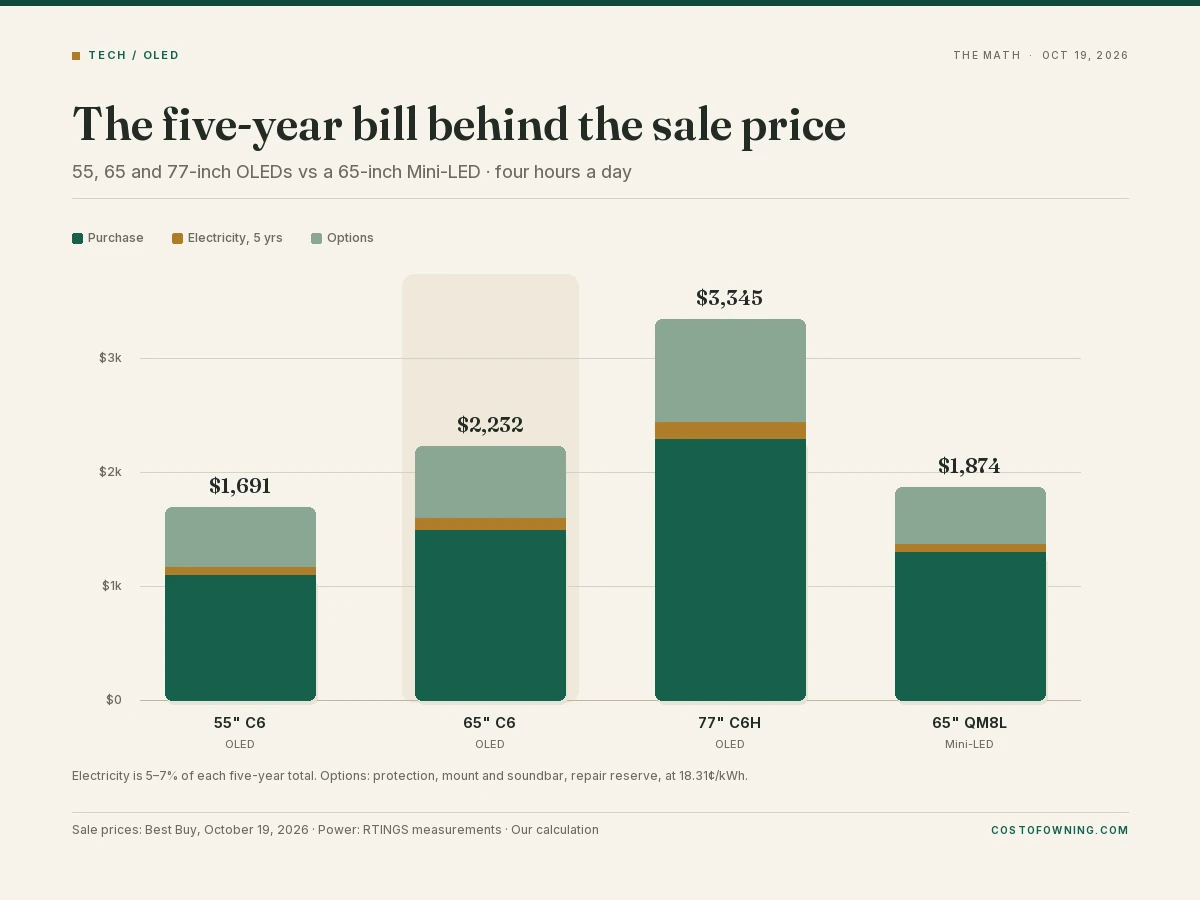
The protection allowance follows Best Buy’s Geek Squad Protection, which lists pixel repair and burn-in coverage for TVs, at a rate we assume as 15% of purchase. Manufacturer warranties mostly do not cover burn-in. Mounting and setup through a service runs roughly $100 to $250, and a basic soundbar starts near $100. A TV is also part of a bigger monthly stack; see our streaming service prices and console cost of ownership guides.
OLED vs Mini-LED
The 65-inch QM8L sale price of $1,299.99 is about $200 less than the 65-inch C6. On power, the mini-LED measured lower typical draw but a higher peak than the OLEDs above, and LCDs with full-array dimming also vary with content. So the common claim that OLED always uses less power is wrong in both directions: per-pixel lighting helps on dark scenes, but a bright HDR image can pull more than a comparable LCD. Electricity is a small enough line that it should not drive the panel choice; the $200 purchase gap is about four decades of the roughly $5 annual difference at these measured draws.
Burn-In and What Warranties Cover
LG’s US television limited warranty lists one year for parts and one year for labor, and the OLED warranty card names image burn-in among its exclusions. LG’s five-year panel warranty covers the G6 and W6, not the C6. In years two through five of that premium coverage, panel parts are covered but labor is not. Samsung’s US home-electronics terms do not promise OLED burn-in coverage; coverage depends on the model, as the US warranty lookup and a warranty comparison database note, and a retailer plan is the practical way to cover it.
Risk tracks use. Static elements such as news tickers, channel logos, score bugs, and game HUDs are the usual cause. RTINGS’ current burn-in research finds resistance has not clearly improved under extreme static use, though sets are brighter; its ten-month longevity results show the same pattern. Mixed viewing, varied content, and the built-in pixel refresh keep risk low for most households. There is no published average lifespan we are willing to quote.
Black Friday, Resale, and the Real Checkout Price
TV discounts historically bottom out between Black Friday and the Super Bowl, and the deepest advertised units are doorbusters with limited stock: What Hi-Fi’s OLED deals guide tracks exactly these windows. Compare the delivered price, not the sticker. Delivery, haul-away, wall mounting, and setup may be added at checkout, and Best Buy’s TV services are priced separately from the TV.
Do not buy around resale. Televisions depreciate steeply, and selling a used 77-inch panel is difficult: it must be transported upright and packed, and a professional move of one oversized item can approach the cost of a small new set. Buy for the years you will watch it.
FAQ
Is Black Friday the best time to buy an OLED?
Often yes for closeout sizes, but the 2026 C6 is already 44% off list at $1,499.99. Doorbusters may go slightly lower with limited stock, so treat the current price as the benchmark.
How much does a 65-inch OLED cost to run?
About $21 to $28 a year at four hours a day and the 18.31 cent US average rate, based on RTINGS’ measured draw and our arithmetic. Heavy HDR use and higher local rates push that up.
Does the manufacturer warranty cover OLED burn-in?
Usually not. LG’s standard US TV warranty runs one year and names burn-in as an exclusion, while its five-year panel warranty applies to G-series and W-series sets. Samsung does not promise burn-in coverage. Best Buy’s Geek Squad Protection does list pixel repair and burn-in coverage.
Should I buy an extended warranty?
Only if the plan covers burn-in and the price is a small share of the set. Manufacturer coverage is one year, and panel repairs are expensive, so the coverage is the main burn-in insurance you can buy.