
A heat pump water heater can justify a higher installed price when it replaces an electric resistance tank, but your price premium and hot-water demand determine payback. Using ENERGY STAR’s modeled annual energy savings and a historical July 2026 national electricity benchmark, a hypothetical $1,500 premium takes about 2.2 years for a four-person household or 4.4 years for two people to recover. Those are calculations under stated assumptions, not a promise about a particular installation.
For an October 2026 purchase, do not subtract the former $2,000 federal home-improvement credit. Its qualifying period ended in 2025. This guide compares replacing an electric tank with another electric tank or a heat pump model. Request an itemized scope for electrical, plumbing, access and disposal work when comparing installation quotes.
Use the Price Difference Between Two Quotes
If repairing the existing heater is still feasible, first compare the written quotes in the water-heater budget worksheet. It keeps the same comparison period for both options and lets you test energy and future-repair allowances without predicting the old tank’s remaining life.
At normal replacement time, the useful comparison is the extra installed cost of a heat pump model over the tank you would otherwise buy. If a conventional electric replacement costs an assumed $1,800 and a heat pump installation costs $3,300, the premium is $1,500. The heat pump does not need to repay the entire $3,300 to outperform that alternative because both choices require spending money.
Replacing a working tank early is different. You are bringing forward a purchase that could otherwise wait. Account for the remaining value of the old equipment and any later replacement you avoid. The simple premium calculation below is most suitable when a replacement is already needed.
Get both quotes on the same basis: tank capacity, removal, permits, electrical work, drain arrangements and warranty. A lower equipment price can disappear once a closet modification or longer condensate run enters the estimate. We use $1,500, $2,500 and $3,500 as hypothetical premiums, rather than claim a nationwide installed price.
Recalculate Energy Savings at Your Rate
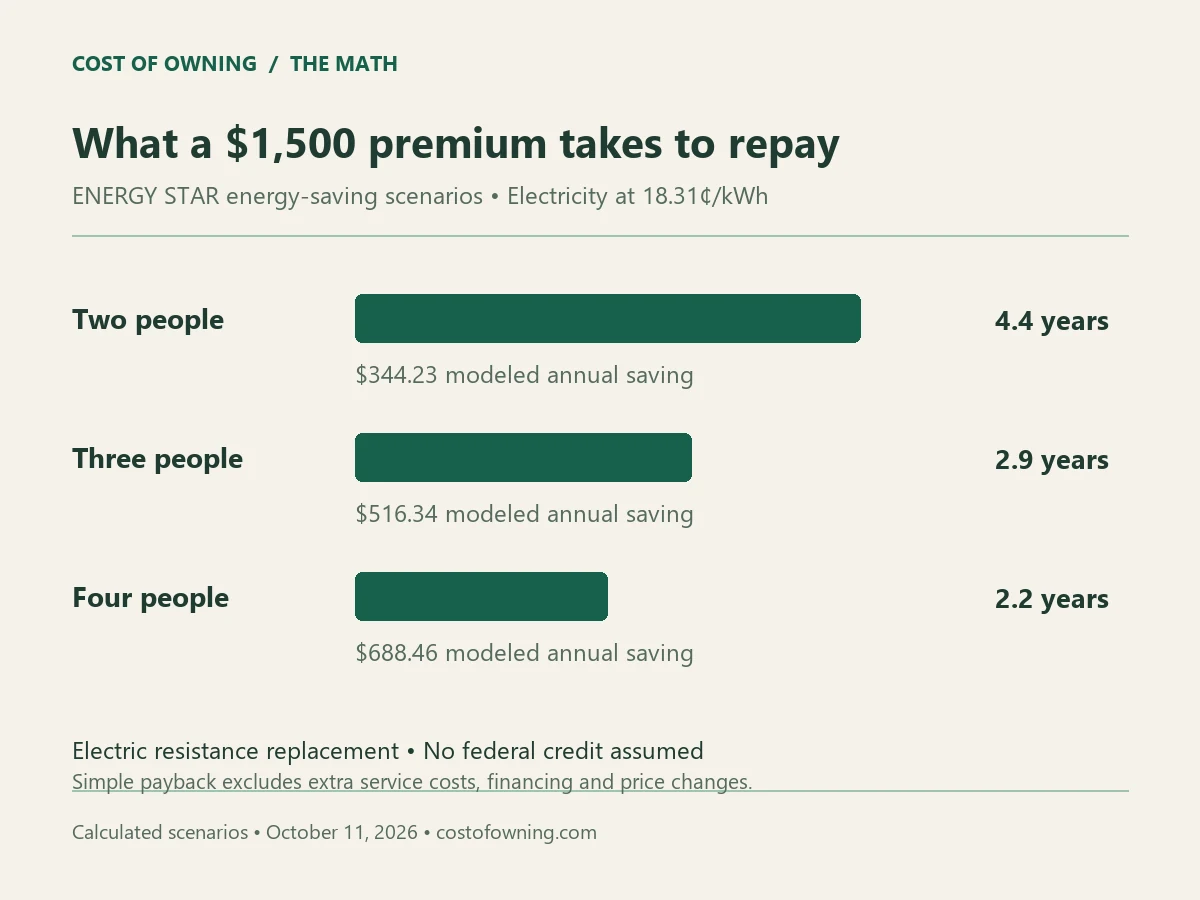
The ENERGY STAR benefits table models annual savings versus standard electric water heating of 1,880 kWh for two people, 2,820 for three and 3,760 for four. Its own dollar examples use roughly 14.6 cents per kWh. We preserve the energy assumptions and substitute 18.31 cents, the historical July 2026 US residential observation in Table_5_06_A.xlsx from EIA’s September 2026 archive. This is a dated benchmark, not the latest release or your current tariff.
| Household scenario | Modeled energy saved each year | Our annual saving at 18.31¢ | Simple payback on a $1,500 premium |
|---|---|---|---|
| Two people | 1,880 kWh | $344.23 | 4.4 years |
| Three people | 2,820 kWh | $516.34 | 2.9 years |
| Four people | 3,760 kWh | $688.46 | 2.2 years |
Annual saving = annual kWh avoided × your price per kWh. Payback = installed premium ÷ annual saving. The EIA benchmark spreads fixed charges and other billed items across kWh; the table uses it only as an illustrative repricing assumption. Actual savings require the usage-linked tariff for electricity you avoid buying. Unchanged fixed monthly utility charges are not savings.
Clarification, October 28, 2026: corrected the earlier “latest” description to identify the July observation and September archive, and distinguished benchmark arithmetic from avoidable household bill savings. The numerical scenarios are unchanged.
These household cases are reference scenarios. Head count alone cannot capture shower length, incoming water temperature, laundry habits or an old tank’s efficiency. A household away much of the year may have much less demand. If two comparable EnergyGuide labels show a smaller kWh difference, use that difference instead and confirm their test conditions match.
How the Installed Premium Changes Payback
Keeping the same energy-saving assumptions and electricity rate produces:
| Extra installed cost | Two-person scenario | Three-person scenario | Four-person scenario |
|---|---|---|---|
| $1,500 | 4.4 years | 2.9 years | 2.2 years |
| $2,500 | 7.3 years | 4.8 years | 3.6 years |
| $3,500 | 10.2 years | 6.8 years | 5.1 years |
For the four-person case, ten years of unchanged modeled energy savings total $6,884.56. After a $2,500 premium, the difference is $4,384.56 before extra maintenance, repairs, financing, discounting or energy-price changes. This is an undiscounted comparison, not an investment return or guaranteed ten-year saving.
A repair budget changes the answer. Suppose you expect an additional $50 a year in service costs for the heat pump option. The four-person net saving becomes $638.46, stretching $2,500 payback to 3.9 years. That $50 is an illustrative allowance, not a measured average. Add the difference between the actual maintenance costs of both options.
Electricity Rates Can Change the Decision
For the four-person energy scenario, annual savings at an assumed 12 cents per kWh are $451.20. A $2,500 premium takes 5.5 years to recover. At 30 cents, savings become $1,128 and payback about 2.2 years. Find a regional starting point in our state electricity bill guide, then use your own utility tariff.
An especially useful question is whether your quote fits a target payback. To recover a $2,500 premium within five years at 18.31 cents, you need to avoid about 2,731 kWh a year before additional costs. That is $500 divided by $0.1831. A low-demand home may fall below that threshold even with efficient equipment.
Time-of-use prices need another adjustment. Multiply avoided use in each rate period by that period’s price. Applying the most expensive evening rate to every saved kWh would overstate savings if the tank usually heats overnight.
Installation and Operating Mode Matter
A heat pump takes heat from surrounding air to warm the tank. Many hybrid models also have resistance elements for high demand. ENERGY STAR’s operating-mode explanation describes why frequent electric-only operation reduces the efficiency advantage. Size the tank for peak demand and ask the installer which mode meets your household’s needs.
ENERGY STAR’s installation FAQ identifies adequate ambient temperature and airflow as key requirements. Manufacturer space requirements commonly fall around 450 to 700 cubic feet; a small closet may require louvers or ducting. The compressor also makes sound and cools the surrounding area. Check the specific manual and location before choosing a tank.
The installation and maintenance guidance calls for accessible filters and condensate drainage. It recommends filter cleaning every six to twelve months, more often in dusty settings, and annual condensate-line cleaning. Ask what the warranty covers for equipment, labor and service visits. Space-heating interaction is also location-dependent, so these tables do not include a universal winter heating penalty or summer cooling credit.
Incentives for an October 2026 Installation
The IRS Energy Efficient Home Improvement Credit page limits the credit to improvements made through December 31, 2025. An older advertisement mentioning a $2,000 heat pump credit should therefore not lower the modeled cost of a new 2026 installation.
State or utility offers may have different eligibility rules. Verify funding, income limits, qualifying model numbers and any required approval before work starts. Subtract only a confirmed incentive from the premium. For example, a hypothetical $500 rebate lowers a $2,500 premium to $2,000; the four-person case would then repay it in about 2.9 years.
FAQ
How quickly does a heat pump water heater pay for itself?
In our electric-tank replacement scenarios, a $1,500 installed premium takes about 2.2 to 4.4 years at 18.31 cents per kWh. A higher premium, lower demand or extra service cost makes payback longer.
Can I claim the old $2,000 federal credit in 2026?
The IRS says the Energy Efficient Home Improvement Credit applies through 2025. We exclude it from new 2026 installation examples. Check separately for current state or utility incentives.
Does this comparison apply when replacing a gas tank?
No. These energy savings compare heat pump and standard electric water heating. A gas conversion needs gas consumption, fuel prices, electrical work and any remaining gas account charges calculated separately.
What number should I put into the payback formula?
Use the extra installed price over your realistic replacement alternative, after confirmed incentives. Divide it by annual avoided energy cost minus any extra ongoing costs. Compare quotes with the same included work.