
A home EV charger needs two prices: the equipment and the electrical work. On October 10, 2026, Tesla’s US home-charging page lists $585 for its Wall Connector and $750–$1,500 for installation. Added together, that is $1,335–$2,085 before tax, assuming the quoted installation fits Tesla’s stated range. Its Universal Wall Connector is $660, bringing the equivalent total to $1,410–$2,160.
Those are manufacturer prices and installation estimates, rather than a nationwide survey or a quote for your garage. They are useful because they separate costs that often get combined into one misleading number. We have not installed or tested these products. This guide uses them as a dated budget example and shows how to compare another charger’s quote.
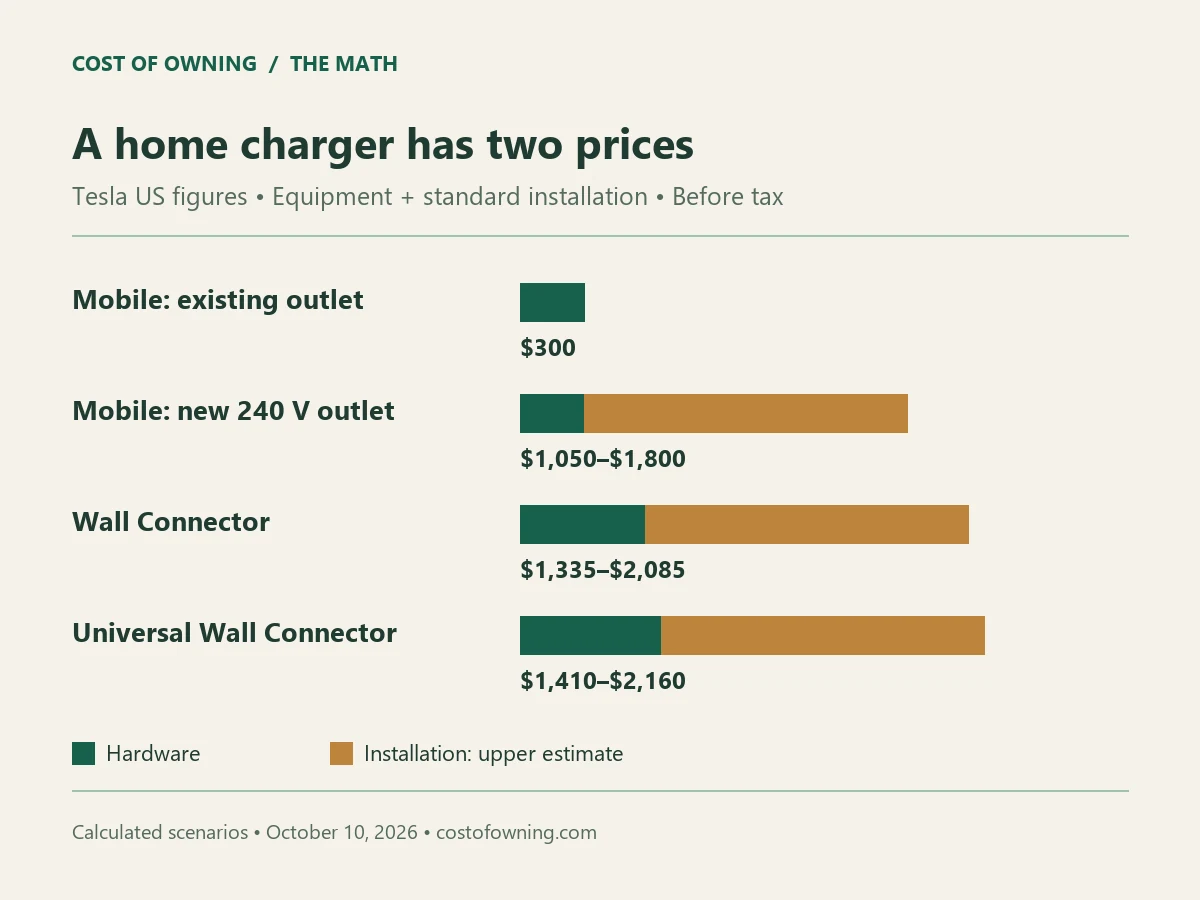
Equipment Plus Installation
| Option | Listed equipment price | Tesla installation estimate | Combined estimate |
|---|---|---|---|
| Mobile Connector, approved existing outlet | $300 | $0 for no new work | $300 |
| Mobile Connector, new 240 V outlet | $300 | $750–$1,500 | $1,050–$1,800 |
| Wall Connector | $585 | $750–$1,500 | $1,335–$2,085 |
| Universal Wall Connector | $660 | $750–$1,500 | $1,410–$2,160 |
The totals are our additions of Tesla’s figures, before tax and any extras. A suitable existing outlet can keep the entry price low, but have an electrician confirm that the outlet and circuit are appropriate for sustained charging. The cheapest equipment is not useful if it cannot replenish your daily driving overnight.
The Wall Connector shop listing independently showed the $585 price when checked. Product availability and checkout pricing can change. Do not budget using an old $450 price copied from an earlier article.
What a Written Quote Should Cover
Ask the installer to itemize the charger, wiring, electrical work, permit, inspection and any panel or service work. Get a clear answer about whether the equipment is included: adding a hardware price to a quote that already includes it counts the charger twice.
Installation costs rise when the parking space is far from the electrical panel, the route needs trenching, or the existing electrical system cannot support the proposed charging load. Hiding wiring behind finished walls and installing an outdoor pedestal can also change the scope. Price those jobs explicitly instead of treating them as routine accessories.
For three comparable quotes, give every installer the same desired location, charger model and charging requirement. Our contractor quote red flags guide helps with the comparison. A cheaper quote missing permits or necessary work is not a cheaper version of the same job.
Do You Really Need the Fastest Setting?
Work backward from daily energy demand. Assume an EV uses 30 kWh per 100 miles; that is our illustrative vehicle input, not a claim about every EV. Driving 40 miles a day requires 12 kWh of energy under that assumption.
For this example, assume 90% charging efficiency. The wall must supply 12 ÷ 0.90 = 13.3 kWh. Over a ten-hour parking window, the required average input is 1.33 kW. An electrician and the vehicle’s specifications determine which charging setup can deliver that safely.
At 80 miles a day, the same assumptions require 26.7 kWh from the wall, or an average of 2.67 kW across ten hours. There is a large difference between meeting that requirement and designing for the vehicle’s maximum charging speed.
Tesla’s Wall Connector specifications advertise up to 11.5 kW at 48 amps, depending on the vehicle, and note lower vehicle limits for certain models. Buying maximum-capacity hardware does not mean every car will accept its maximum output. Discuss lower charging power or approved load management with the electrician before assuming a service upgrade is necessary.
What Charging Adds to the Bill
Use electricity measured at the wall where possible. If your efficiency figure already includes charging losses, do not add the same loss allowance again.
For a 12,000-mile year at an assumed 30 kWh per 100 miles from the wall, annual consumption is 3,600 kWh, or 300 kWh a month. At the EIA’s July 2026 residential average of 18.31 cents per kWh, that is $659.16 a year or $54.93 a month. The average is a reference point; use your actual charging tariff.
| Assumed charging rate | Monthly bill at 300 kWh | Annual bill at 3,600 kWh |
|---|---|---|
| $0.12/kWh | $36 | $432 |
| $0.1831/kWh | $54.93 | $659.16 |
| $0.30/kWh | $90 | $1,080 |
| $0.45/kWh | $135 | $1,620 |
If the assumed 30 kWh represents battery-side energy instead, the illustrative 90% efficiency makes wall consumption 4,000 kWh a year. At the EIA rate that costs about $732.40 annually, or $61.03 monthly. Our home EV charging cost guide covers the per-mile comparison.
The Federal Credit Has Closed for New Installations
The IRS’s current guidance says eligible charging property had to be placed in service by June 30, 2026 for the federal section 30C credit. An installation placed in service now, in October, should not be budgeted with that expired credit.
Utility and state offers are separate programs. Verify eligibility, approved equipment, funding availability and any pre-approval requirement directly with the program administrator before ordering. An EV electricity tariff discount also differs from a rebate on installation.
Five-Year Cost of the Charging Setup
Suppose the electrician quotes an assumed $1,200 installation for the $585 Wall Connector. Upfront cost is $1,785 before tax. Add five years at $659.16 of annual charging electricity, holding mileage and rate constant, and the setup plus electricity totals $5,080.80.
That does not include the car, insurance, maintenance or resale. It is a charging budget, not a total EV ownership figure. Our car ownership calculator covers the broader comparison. For the charger decision itself, the most valuable next step is a written electrical quote and a realistic nightly charging requirement.
FAQ
How much does a home EV charger cost to install?
Tesla currently estimates $750–$1,500 for its wall-charger installation, plus equipment. Its $585 Wall Connector produces a combined $1,335–$2,085 estimate before tax and work outside that scope.
Can I charge from an existing outlet?
Possibly. Have an electrician approve the circuit for charging and confirm that its charging speed meets your daily driving needs. A new outlet is a separate installation expense.
Is the federal home charger tax credit still available?
The IRS says qualifying property must have been placed in service by June 30, 2026. Do not deduct it from an October installation budget. Check separate state and utility offers.
How much electricity does a 12,000-mile year require?
At our assumed 30 kWh per 100 miles from the wall, it is 3,600 kWh annually, or 300 monthly. If your consumption input excludes charging losses, account for those separately.